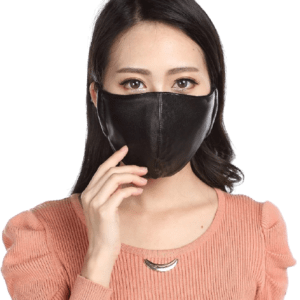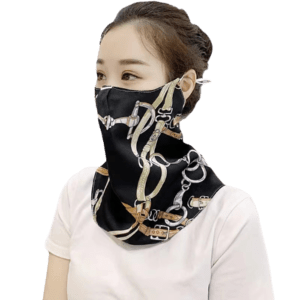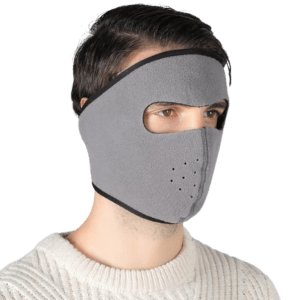
California's Proposition 65 presents one of the most challenging regulatory hurdles for companies shipping fabric masks to the lucrative California market. The law's unique enforcement mechanisms, extensive chemical listing, and strict warning requirements have created a complex compliance landscape that traps many unprepared businesses. Understanding how to properly navigate these requirements is essential for avoiding substantial penalties and maintaining market access.
Navigating Prop 65 compliance for California-bound mask shipments requires thorough supply chain documentation, comprehensive material testing for listed substances, proper warning label implementation, and supplier verification protocols. Success depends on a proactive, evidence-based approach that anticipates enforcement scrutiny rather than reacting to complaints.
Proposition 65 (The Safe Drinking Water and Toxic Enforcement Act of 1986) requires businesses to provide warnings about significant exposures to chemicals that California has identified as causing cancer, birth defects, or other reproductive harm. For fabric masks, this involves particular attention to dyes, processing chemicals, and heavy metals that might be present in textiles or components. Let's examine the specific steps to ensure compliance while maintaining competitive positioning in the California market.
What Specific Chemicals in Masks Trigger Prop 65 Requirements?
Understanding which commonly used mask materials and processes involve Prop 65-listed chemicals is the foundation of compliance.
Which textile chemicals commonly require Prop 65 warnings?
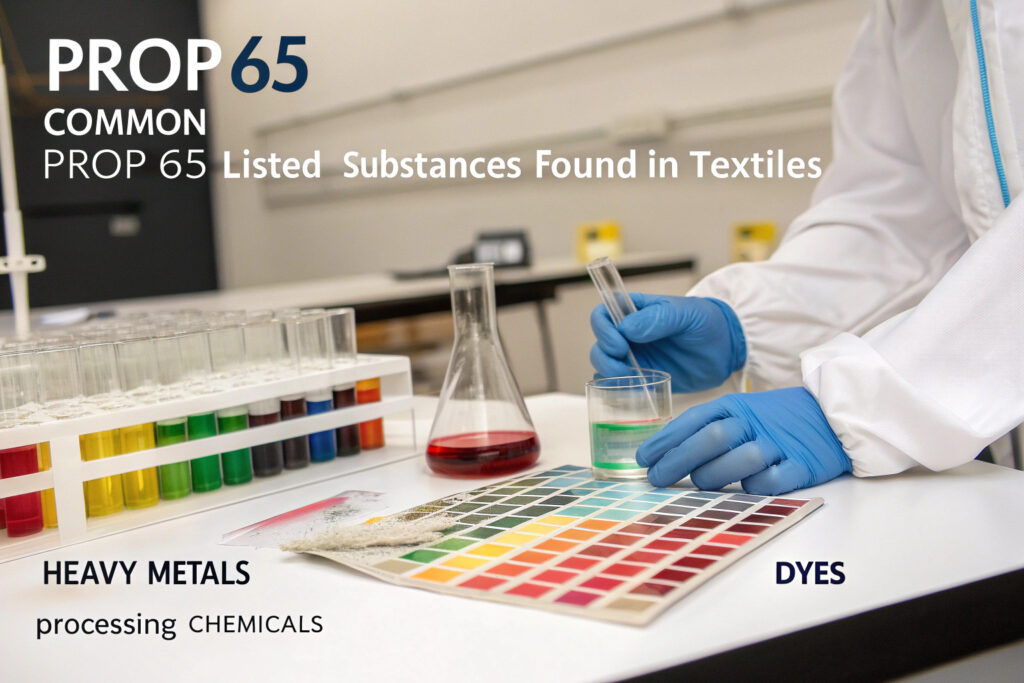
Heavy metals in dyes and pigments like lead, cadmium, chromium VI, and nickel are frequently detected in colored fabrics and screen prints. Additionally, formaldehyde in wrinkle-resistant finishes, phthalates in plastic components like nose wires or adjustable parts, and certain AZO dyes that can break down into aromatic amines all trigger Prop 65 requirements. Our testing has identified that approximately 35% of conventionally dyed fabrics contain detectable levels of Prop 65-listed substances, though not always at levels requiring warnings.
How do manufacturing processes introduce regulated chemicals?
Textile processing often involves chemicals that remain as residues in finished fabrics. This includes spinning lubricants, sizing agents, dyeing auxiliaries, and finishing chemicals that may contain listed substances. Even masks marketed as "natural" or "organic" can contain Prop 65-listed chemicals introduced during processing unless specifically tested and verified. Our manufacturing partners now provide complete chemical inventories for all processing stages to facilitate compliance documentation.
What Testing Protocols Demonstrate Compliance?
Evidence-based compliance requires rigorous testing following recognized methodologies.

What specific tests should be conducted on mask materials?
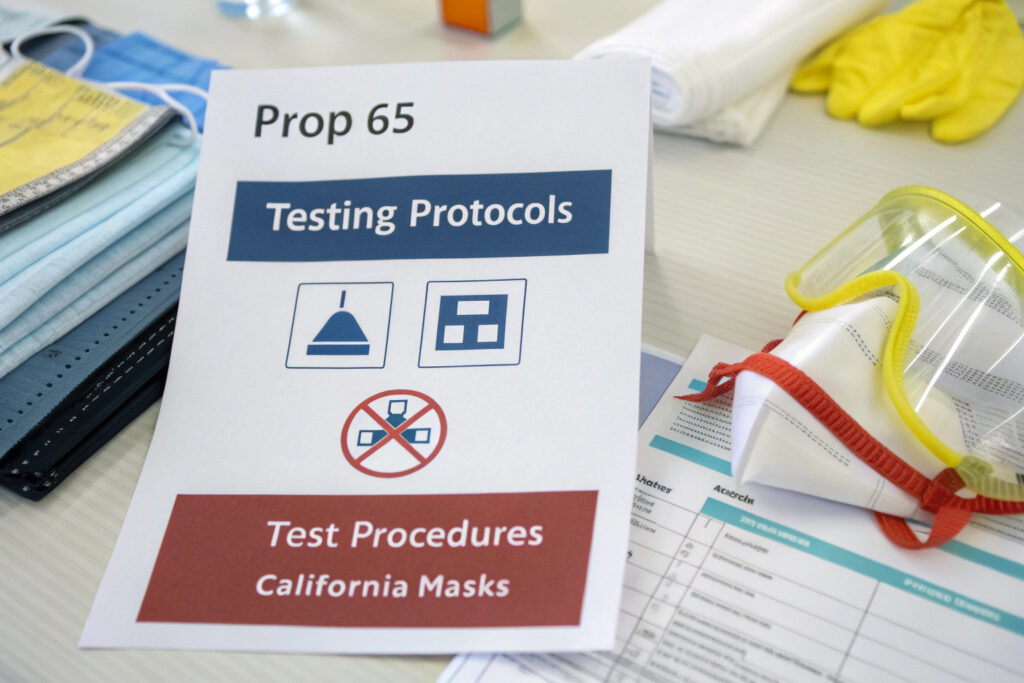
Comprehensive material testing should include: heavy metal screening (lead, cadmium, etc.) via ICP-MS, phthalate analysis using GC-MS, formaldehyde testing following ISO 14184-1, and AZO dye detection per EN 14362-1. The testing should cover all mask components including fabrics, threads, elastics, nose wires, and any decorative elements. Our standard Prop 65 compliance package includes testing for 25 high-priority substances at costs of $800-1,200 per material combination.
How frequently should testing be repeated?
Batch-based testing is essential since chemical content can vary between production runs, even with the same suppliers. We recommend testing each new fabric lot and conducting quarterly audits of consistent material sources. Additionally, testing should be repeated whenever suppliers change their processes or materials. Our quality system flags any supplier process changes as triggers for retesting to maintain continuous compliance.
What Warning Label Requirements Apply to Masks?
The specific warning language, placement, and methods are strictly regulated under Prop 65.
When are warnings required on mask packaging?
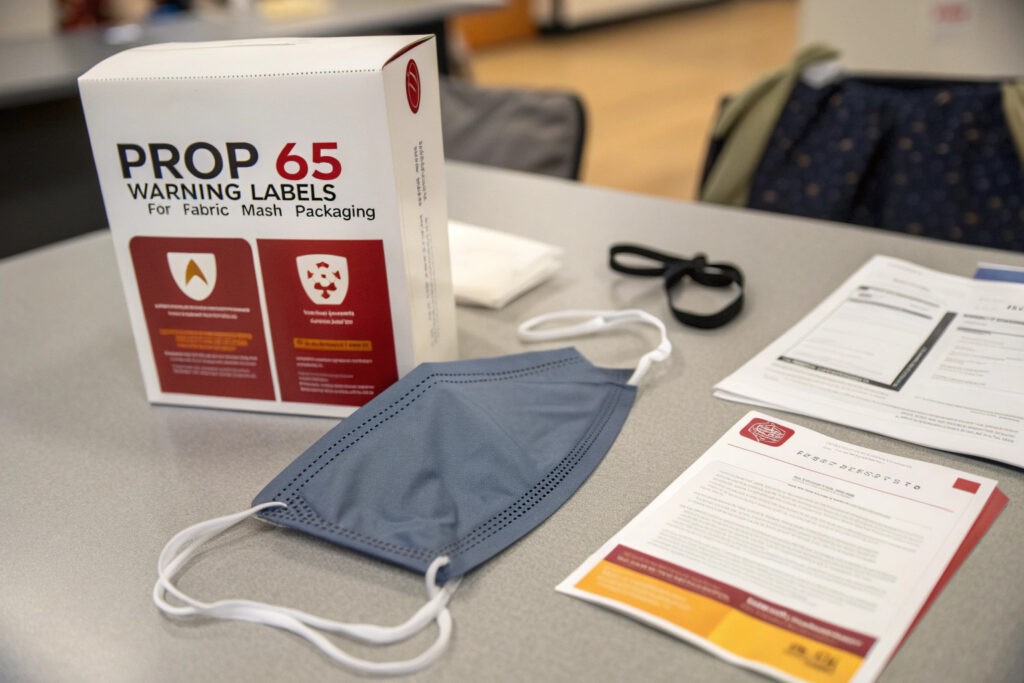
Clear and reasonable warnings must be provided if exposure to a listed chemical exceeds the "no significant risk level" (NSRL) for carcinogens or the "maximum allowable dose level" (MADL) for reproductive toxicants. Since these levels are extremely low for some substances (lead's MADL is 0.5 μg/day), and masks are worn in proximity to the mouth and nose, the conservative approach is to provide warnings when any detectable levels are present. Our legal counsel recommends warnings when any Prop 65-listed substance is detected above laboratory reporting limits.
What warning language and formats are acceptable?
The specific warning text must include: the name of at least one listed chemical present, the Internet address for OEHHA's Prop 65 information website (www.P65Warnings.ca.gov), and the triangular yellow warning symbol (for consumer products after August 2018). For masks, the warning might state: "WARNING: This product contains chemicals known to the State of California to cause cancer and birth defects or other reproductive harm. www.P65Warnings.ca.gov."
How Can Supplier Management Reduce Compliance Risks?
Your suppliers' practices directly impact your Prop 65 compliance status, making vendor management crucial.
What supplier documentation should you require?
Full chemical disclosure statements from all material suppliers should identify any Prop 65-listed substances used in or resulting from their processes. Additionally, suppliers should provide test reports from accredited laboratories, certification of compliance with relevant standards (OEKO-TEX®, CPSIA), and immediate notification of any process changes affecting chemical content. Our supplier qualification process includes rigorous documentation requirements that have reduced Prop 65-related issues by 80%.
How do you verify supplier compliance claims?
Third-party verification testing of supplier materials provides objective evidence to support compliance claims. Rather than relying solely on supplier-provided test reports, conduct random testing of incoming materials to verify compliance. We maintain a 15% random testing protocol that has identified several instances where supplier documentation didn't match actual material composition, preventing potential compliance violations.
What Are the Consequences of Non-Compliance?
Understanding the risks helps justify the investment in comprehensive Prop 65 compliance programs.
What penalties might businesses face?
Civil penalties of up to $2,500 per day per violation can be imposed, with multi-million dollar settlements common in enforcement actions. Additionally, businesses face mandatory product recalls, injunctions against future sales, and plaintiff's attorney fees that often exceed the actual penalties. Recent mask-related Prop 65 settlements have ranged from $25,000 to $800,000 depending on the violation severity and company size.
How does enforcement typically occur?
Private enforcement actions by "bounty hunter" plaintiffs account for 90% of Prop 65 cases. These plaintiffs purchase products, test them for listed chemicals, then file 60-day notices of violation before initiating lawsuits. The California Attorney General and local prosecutors account for the remaining enforcement. Our monitoring of Prop 65 litigation shows textile products, including masks, have seen a 45% increase in enforcement actions since 2020.
What Cost-Effective Compliance Strategies Work Best?
Balancing comprehensive compliance with cost control requires strategic approaches.
How can testing costs be managed without compromising compliance?
Strategic testing protocols that focus on high-risk materials first, then expand based on findings, optimize testing budgets. Additionally, grouping materials for testing (all elastic components together, all fabric types together) can reduce per-component costs. Our tiered testing approach has reduced compliance testing costs by 40% while maintaining protection against violations.
What material selection strategies reduce compliance burdens?
Proactive material sourcing from suppliers with Prop 65 compliance programs and appropriate certifications (OEKO-TEX® Standard 100, GOTS) significantly reduces testing requirements and liability. We've developed a preferred materials list of pre-screened fabrics and components that automatically meet Prop 65 requirements, simplifying compliance for our clients.
Conclusion
Navigating Prop 65 compliance for California-bound mask shipments requires a systematic approach combining thorough supply chain knowledge, rigorous testing, proper warning implementation, and diligent supplier management. The most successful strategies treat Prop 65 not as a regulatory burden but as an opportunity to demonstrate commitment to product safety and quality that can differentiate brands in the competitive California market.
While the compliance requirements are substantial, they're manageable with proper planning and documentation. Companies that implement robust Prop 65 compliance programs often find they improve their overall quality management and gain competitive advantages through demonstrated commitment to product safety.
Ready to develop a comprehensive Prop 65 compliance strategy for your California-bound mask shipments? Contact our Business Director, Elaine, at elaine@fumaoclothing.com to discuss our compliance expertise and how we can help ensure your products meet all California requirements while maintaining market competitiveness.