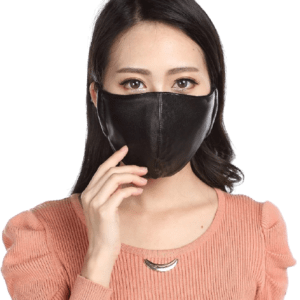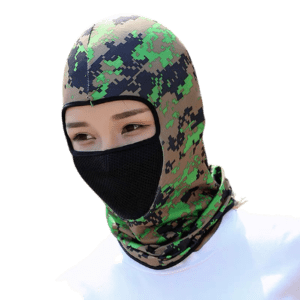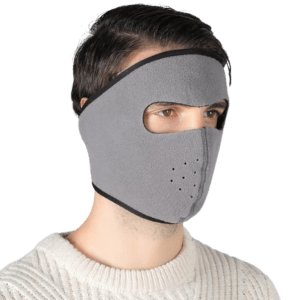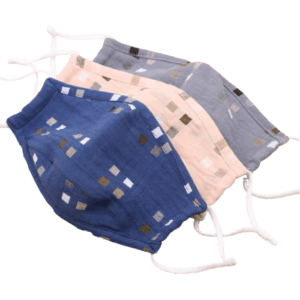

Traditional smart masks collect environmental data but struggle to process it efficiently, leading to high power consumption and delayed responses. The emerging field of neuromorphic engineering offers a transformative solution by mimicking the brain's architecture directly within textile structures. For procurement specialists seeking next-generation intelligent protection, understanding how to source masks with neuromorphic sensory processing is becoming essential for competitive differentiation.
Masks with neuromorphic sensory processing incorporate hardware systems that emulate biological neural networks at the physical level, enabling real-time, energy-efficient analysis of multiple sensor inputs directly at the edge—on the mask itself—without constant cloud connectivity. This technology allows masks to learn user breathing patterns, recognize specific environmental threats, and adapt protection parameters through spike-based computing that consumes milliwatts rather than watts of power. Successful sourcing requires understanding both the novel hardware architectures and their integration challenges into wearable, flexible formats.
The global neuromorphic computing market is projected to reach $8.3 billion by 2030, with wearable applications representing the fastest-growing segment. Unlike traditional microprocessors that separate memory and processing, neuromorphic chips colocate them in artificial synapses, enabling pattern recognition and adaptive responses with extreme efficiency. For mask applications, this means continuous monitoring and intelligent response without bulky batteries or heat generation. Let's explore the practical pathways to sourcing this revolutionary technology.
What Neuromorphic Hardware Architectures Are Suitable for Masks?
Several neuromorphic hardware approaches have emerged, each with different trade-offs in power, flexibility, and manufacturability for textile integration.

Are Memristor Crossbar Arrays Feasible for Textile Integration?
Memristor crossbar arrays, where programmable resistors sit at the intersections of perpendicular nanowires, create dense neural network hardware that can be fabricated on flexible polyimide substrates. These arrays excel at vector-matrix multiplication—the core operation in neural networks—with exceptional energy efficiency. Research from Nature Electronics demonstrates flexible memristor arrays achieving 50 TOPS/W (tera-operations per second per watt), making them ideal for always-on sensory processing in masks. The key sourcing challenge is finding suppliers who can produce these arrays with sufficient yield and stability for consumer products. Our development partners are advancing roll-to-roll manufacturing techniques to integrate memristor networks directly onto textile backing layers.
How Do Spiking Neural Network (SNN) Chips Differ?
Dedicated SNN chips like Intel's Loihi or BrainChip's Akida implement the brain's event-driven communication model, where neurons only transmit signals ("spikes") when inputs reach a threshold. This asynchronous operation is incredibly power-efficient for processing sparse, event-based sensor data from masks, such as detecting a sudden cough, a spike in particulates, or a change in breathing rhythm. According to specifications from BrainChip Holdings, their Akida processor can perform real-time sensor fusion for multiple environmental inputs while consuming under 100 milliwatts. For sourcing, look for chip providers offering miniature, chip-scale packages that can be embedded in mask nose bridges or side panels without compromising comfort.
How Is Sensor Fusion Achieved On-Device?
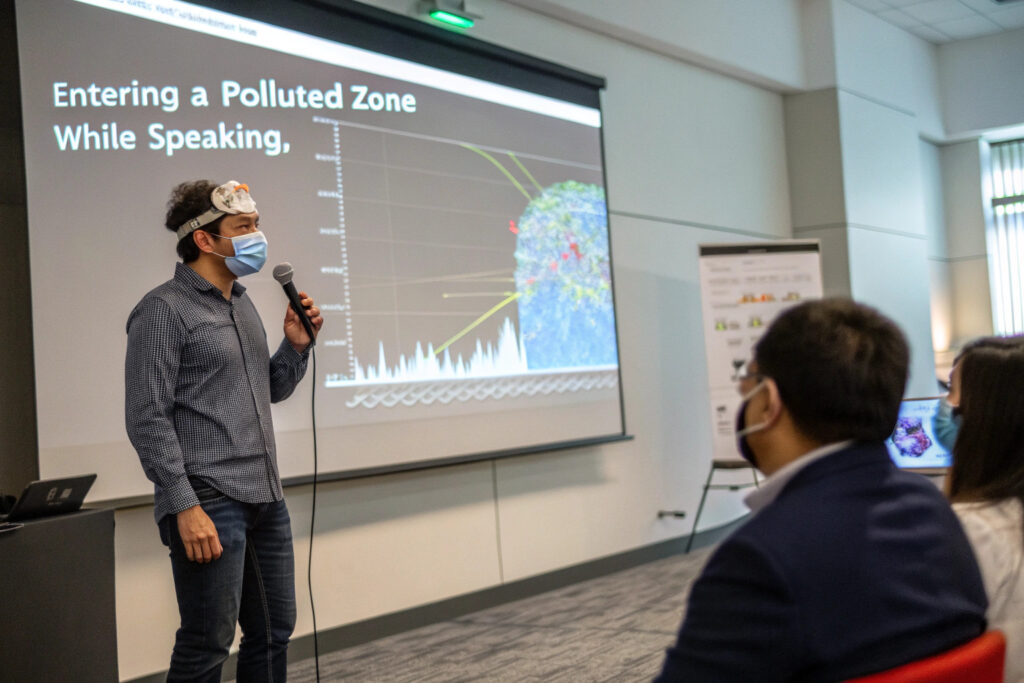
Neuromorphic processing shines in its ability to integrate and interpret data from multiple heterogeneous sensors—such as particulate counters, gas sensors, microphones, and strain gauges—in real time to form a coherent understanding of the environment and the wearer's state.
What Learning Algorithms Enable Personalized Adaptation?
On-device learning algorithms, particularly spike-timing-dependent plasticity (STDP), allow neuromorphic masks to adapt to individual users without external programming. STDP adjusts the strength of connections between artificial neurons based on the timing of their spikes, mimicking how brains learn associations. For example, a mask can learn to associate a specific head movement pattern with the need for a tighter seal, or recognize the unique sound signature of the wearer's cough versus ambient noise. Papers from the Neuromorphic Computing and Engineering journal detail implementations where STDP enables masks to personalize their response thresholds within just a few wear cycles. When sourcing, verify that the hardware supports such in-field learning, not just pre-trained, static models.
How is Real-Time Threat Classification Performed?
Classification happens through layers of spiking neurons that extract increasingly abstract features from raw sensor streams. A first layer might detect basic events like "increased particle count." A deeper layer could combine particle data with geolocation and sound to classify the event as "walking past a construction site" versus "indoor aerosol generation." This hierarchical, event-driven processing happens with latencies under 100 milliseconds. The key sourcing specification is the number of neuromorphic cores and their supported neuron/synapse counts, which determine the complexity of classifiable threats. For most mask applications, systems capable of simulating 10,000-100,000 neurons are sufficient for robust environmental awareness.
What Are the Key Integration and Power Considerations?
Integrating neuromorphic hardware into a soft, flexible, and breathable mask presents unique challenges distinct from those in rigid electronics.
Which Interconnect Technologies Maintain Reliability Under Flex?
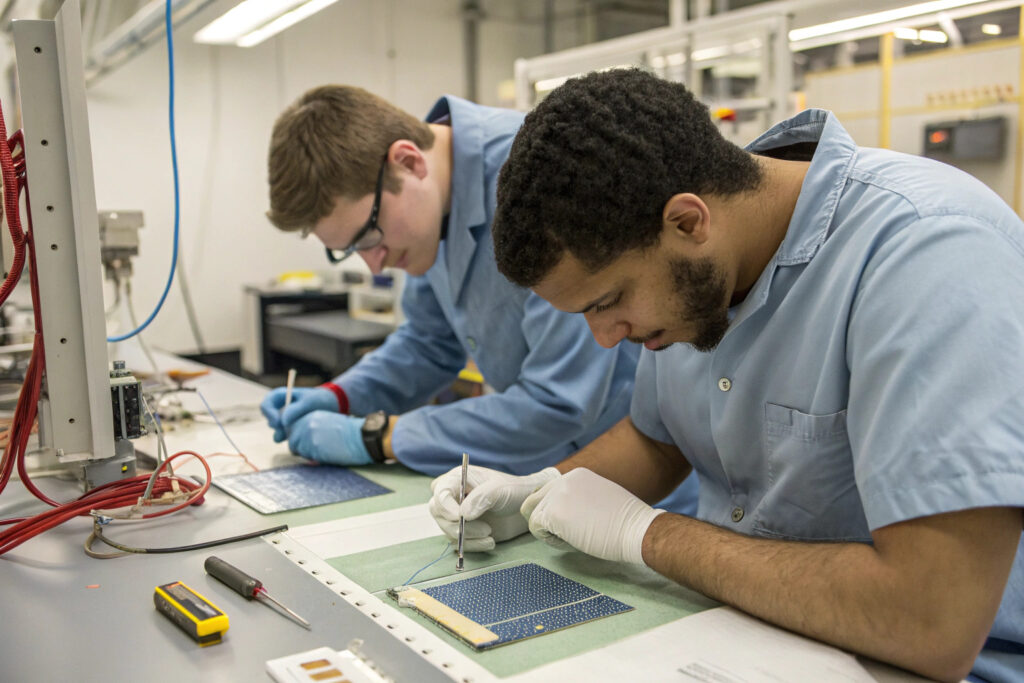
Standard soldered connections fail under repeated flexing. Advanced solutions include stretchable silver nanowire or liquid metal (e.g., Gallium-Indium-Tin) traces embedded in elastomers like PDMS. These interconnects can withstand thousands of bending cycles without significant resistance increase. Furthermore, neuromorphic architectures themselves can be made fault-tolerant by design, allowing them to maintain function even if a small percentage of connections degrade. Sourcing should involve partners with proven expertise in flexible hybrid electronics, as this is a specialized field bridging PCB assembly and textile engineering.
How Are Power Requirements Minimized and Met?
The ultra-low power nature of neuromorphic processing (often sub-milliwatt for basic sensing) opens novel power sourcing possibilities. Energy harvesting from body heat (via thermoelectric generators), minute mask movement (via piezoelectric fibers), or ambient light can potentially power the system indefinitely for baseline monitoring. A small coin cell or thin-film battery can handle peak processing loads. When evaluating suppliers, examine the system's power budget breakdown and the supported energy harvesting inputs. A well-designed system should specify a "zero-power" idle state where only essential sensory neurons are active, waking the full network only when potential threats are detected.
How to Evaluate Supplier Capabilities and Authenticity?
The field is ripe with aspirational claims. Discerning genuine technical capability from marketing hype is critical for successful sourcing.
What Benchmarks Verify Real-World Performance?
Request standardized benchmark results. For neuromorphic systems, relevant benchmarks include the accuracy and latency on tasks like "Google Speech Commands" for audio event detection or sensor fusion tasks defined by the International Neuromorphic Systems Symposium. Crucially, these benchmarks must report power consumption simultaneously. Be wary of suppliers only showing simulation results or performance on easy datasets. Demand testing on data representative of real mask use: noisy environments, varied speaking patterns, and complex pollutant mixtures.
What Proof of Manufacturing Scalability is Required?
A lab prototype is far from a mass-producible component. Require evidence of manufacturing readiness: a multi-project wafer (MPW) run demonstrating yield, reliability data from accelerated life testing (temperature, humidity, flex cycles), and a roadmap to cost reduction. Suppliers should be able to discuss their packaging strategy (e.g., chip-on-flex, wafer-level packaging) and how it protects the silicon from moisture and mechanical stress. Given the novelty, partnering with suppliers who have a clear path from pilot production to high volume is essential to mitigate supply risk.
Conclusion
Sourcing masks with genuine neuromorphic sensory processing requires moving beyond conventional electronics suppliers to engage with specialized hardware startups, advanced research institutes, and flexible electronics integrators. The core value proposition—intelligent, real-time adaptation with minimal power—is revolutionary for personal protective equipment, enabling masks that are truly context-aware and proactive. Success hinges on thoroughly evaluating hardware architectures, on-device learning capabilities, integration ruggedness, and supplier maturity.
Ready to explore integrating neuromorphic intelligence into your next-generation mask products? Contact our Business Director, Elaine, at elaine@fumaoclothing.com. We are actively partnering with leaders in neuromorphic hardware to bridge the gap between cutting-edge research and manufacturable, comfortable mask solutions.