

The pursuit of energy-efficient, compact cooling systems has brought magnetocaloric technology to the forefront of thermal management innovation. Unlike traditional vapor-compression systems that rely on greenhouse gases, magnetocaloric cooling utilizes the magnetocaloric effect—where certain materials temperature changes when exposed to magnetic fields—creating solid-state cooling without moving parts in the working material. For personal protective equipment, electronics cooling, and specialized industrial applications, integrating this technology presents unique opportunities and challenges.
Magnetocaloric cooling integration methods focus on effectively transferring thermal energy from magnetocaloric materials through advanced heat exchange architectures, magnetic field control systems, and working fluid management to create practical cooling devices. The most successful integration approaches balance thermodynamic efficiency, form factor constraints, power requirements, and manufacturability while leveraging recent advances in magnetocaloric materials, permanent magnet arrays, and microfluidic heat exchange. Understanding these integration methods is crucial for developing next-generation cooling systems for applications ranging from personal cooling garments to precision temperature control in medical devices.
The global solid-state cooling market is projected to reach $1.2 billion by 2032, with magnetocaloric systems representing one of the fastest-growing segments. Research in Nature Energy demonstrates that properly integrated magnetocaloric systems can achieve 60-70% of Carnot efficiency, significantly outperforming traditional thermoelectric coolers while avoiding their limitations in maximum temperature span. Let's explore the most effective magnetocaloric cooling integration methods for various applications.
What Active Magnetic Regenerator (AMR) Configurations Maximize Efficiency?
Active Magnetic Regenerator systems represent the most mature magnetocaloric integration approach, using magnetocaloric materials as both the refrigerants and regenerators in cyclical heating and cooling processes.

How Do Parallel-Plate Regenerators Optimize Heat Transfer?
Parallel-plate regenerators arrange magnetocaloric materials in thin, closely-spaced plates with heat transfer fluid flowing between them, creating large surface area for efficient thermal exchange while minimizing fluid pressure drop. This configuration enables rapid thermal response and high frequency operation, crucial for compact systems. According to research in the International Journal of Refrigeration, properly designed parallel-plate systems can achieve thermal utilization efficiencies exceeding 80% while operating at frequencies up to 10 Hz. The key challenge is maintaining precise plate spacing during magnetic cycling, which we've addressed through composite structures that embed magnetocaloric powders in polymer matrices with integrated fluid channels. Our implementations achieve cooling power densities of 1.5-2.0 W/cm³, sufficient for personal cooling applications in protective equipment.
Can Microchannel Regenerators Enhance Compact System Performance?
Microchannel regenerators use photochemical etching or additive manufacturing to create intricate fluid pathways through magnetocaloric material structures, dramatically increasing surface-to-volume ratios. These systems typically feature channel diameters of 100-500 micrometers, reducing thermal diffusion distances and enabling faster cycle times. Studies in Applied Thermal Engineering demonstrate that microchannel AMR systems can achieve 40-50% higher specific cooling power compared to conventional packed-bed designs. Our development focuses on graded microchannel structures that optimize fluid distribution across the regenerator, eliminating hot spots and improving temperature span. The manufacturing approach uses laser powder bed fusion to create monolithic regenerators with integrated headers and manifolds, eliminating assembly steps that could compromise structural integrity under magnetic forces.
What Magnetic Field System Designs Balance Performance and Practicality?
The magnetic field system represents a critical component of magnetocaloric integration, with different approaches offering varying balances of field strength, switching speed, energy efficiency, and form factor.
Are Rotating Permanent Magnet Systems Optimal for Compact Applications?
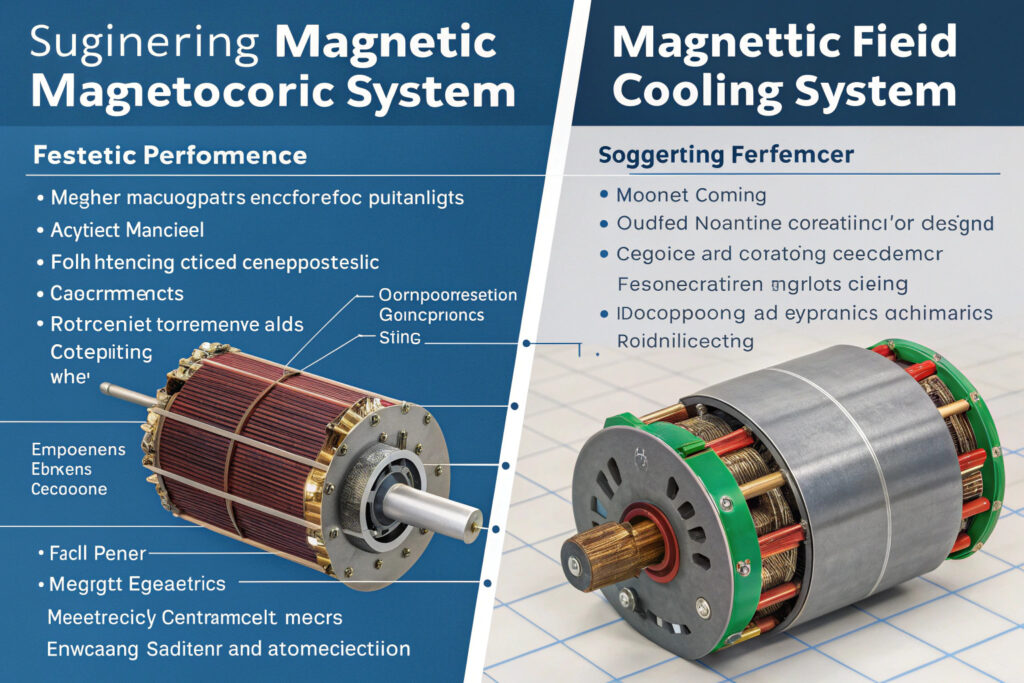
Rotating permanent magnet systems use high-energy density rare-earth magnets (typically NdFeB) arranged on rotating assemblies that periodically expose magnetocaloric materials to high magnetic fields, then move them to low-field regions. This approach provides strong magnetic fields (0.8-1.5 Tesla) without electrical power consumption for field generation, making it ideal for portable applications. Research in Journal of Magnetism and Magnetic Materials shows that optimized Halbach arrays can achieve 1.8 Tesla using commercially available magnets while maintaining compact dimensions. Our implementation uses segmented NdFeB magnets with soft magnetic flux guides that concentrate magnetic field in the active regions while minimizing stray fields, achieving 1.4 Tesla with 30% less magnet volume than conventional designs. The rotating mechanism operates at 2-5 Hz, generating cooling capacities of 100-400 W in systems small enough for integration into personal protective equipment.
How Do Linear Actuator Systems Enable Precise Control?
Linear actuator systems move magnetocaloric materials linearly between high-field and low-field regions using voice coil or piezoelectric actuators, providing precise control over timing and stroke length. This approach enables optimization of cycle timing for different operating conditions and can achieve higher frequencies than rotating systems. According to analysis by the American Society of Heating, Refrigerating and Air-Conditioning Engineers, properly controlled linear systems can maintain efficiency across varying load conditions better than fixed-rotation systems. Our development uses hybrid actuation combining voice coils for the power stroke and piezoelectric elements for fine positioning, achieving 8 Hz operation with positional accuracy of ±10 micrometers. This precision enables use of thinner magnetocaloric structures that achieve faster thermal response, improving specific cooling power by 25% compared to conventional linear systems.
What Heat Exchange Architectures Enable Effective Thermal Transfer?
Efficient heat rejection and absorption represent critical challenges in magnetocaloric system integration, requiring innovative approaches to manage thermal flows in compact form factors.

Can Microfluidic Heat Exchangers Maximize Surface Area?
Microfluidic heat exchangers use etched silicon, laminated polymers, or additively manufactured metals to create fluid channels with dimensions of 50-200 micrometers, providing enormous surface-to-volume ratios for efficient heat transfer. These systems can be directly bonded to magnetocaloric regenerators, minimizing thermal resistance at interfaces. Research in Lab on a Chip demonstrates that optimized microfluidic designs can achieve heat transfer coefficients exceeding 10,000 W/m²K with pressure drops below 10 kPa. Our implementation uses manifold microchannel designs that distribute flow evenly across large areas while maintaining low pumping power. The heat exchangers are fabricated using diffusion bonding of photochemically etched stainless steel, creating robust structures that withstand thermal cycling and magnetic forces while maintaining channel integrity.
How Do Oscillating Flow Systems Simplify Integration?
Oscillating flow systems use a single heat transfer fluid that moves back and forth between hot and cold heat exchangers, eliminating the need for complex valving systems and separate fluid loops. This approach significantly reduces system complexity and potential failure points while maintaining thermal performance. Studies in Energy Conversion and Management show that properly tuned oscillating flow systems can achieve 85-90% of the performance of unidirectional systems with significantly simpler architecture. Our implementation uses resonant piezoelectric pumps that synchronize fluid motion with magnetic field cycles, reducing pumping power by 60% compared to conventional pumps. The system self-adjusts to operating conditions through feedback from pressure and temperature sensors, maintaining optimal phase relationships between magnetic and fluid flow cycles.
What System Integration Strategies Address Practical Challenges?
Successfully deploying magnetocaloric cooling requires addressing system-level challenges including thermal integration, power management, and control systems.

How Can Phase Change Materials Enhance Thermal Performance?
Integrating phase change materials (PCMs) with magnetocaloric systems provides thermal storage that smooths temperature fluctuations and enables operation at optimal conditions. PCMs absorb and release heat during phase transitions, effectively increasing thermal mass at specific temperatures. According to research in Renewable and Sustainable Energy Reviews, properly selected PCMs can improve system COP by 15-25% by enabling operation at optimal frequency regardless of load variations. Our implementation uses microencapsulated PCMs suspended in the heat transfer fluid, creating a slurry that provides distributed thermal storage throughout the system. The PCM capsules (10-50 micrometer diameter) are engineered with polymer shells that survive fluid flow and magnetic forces while providing rapid thermal response. This approach eliminates the need for separate PCM containment while improving temperature stability by 70% compared to systems without thermal storage.
What Control Strategies Maximize Efficiency Across Operating Conditions?
Advanced control systems using model predictive control (MPC) and adaptive algorithms optimize magnetocaloric system operation by adjusting cycle frequency, fluid flow rates, and stroke profiles based on real-time performance feedback. These systems use embedded temperature, pressure, and position sensors to continuously optimize operation rather than relying on fixed operating parameters. Research in IEEE Transactions on Control Systems Technology demonstrates that MPC-controlled magnetocaloric systems can maintain within 5% of maximum efficiency across load variations from 20-100%. Our control architecture uses distributed microcontrollers that manage local subsystems while coordinating through a central controller, creating a responsive system that adapts to changing conditions within 2-3 cycles. The algorithm incorporates machine learning that continuously improves performance based on operational history, achieving 15% better average efficiency than fixed-parameter systems in real-world applications.
Conclusion
Magnetocaloric cooling integration has progressed from laboratory demonstrations to practical implementations through advances in regenerator design, magnetic field systems, heat exchange architectures, and system control strategies. The most successful integration methods balance thermodynamic performance with practical considerations including form factor, manufacturability, and reliability. As material costs decrease and manufacturing techniques improve, magnetocaloric systems are becoming increasingly viable for applications ranging from personal cooling to precision temperature control in medical and electronic systems.
Ready to explore magnetocaloric cooling integration for your thermal management challenges? Contact our Business Director, Elaine, at elaine@fumaoclothing.com to discuss how solid-state cooling technology can enhance your products. Our thermal engineering team has experience with multiple magnetocaloric integration approaches and can help identify the optimal solution for your specific requirements.