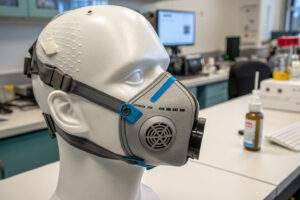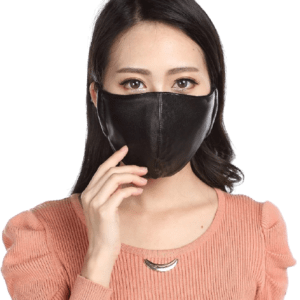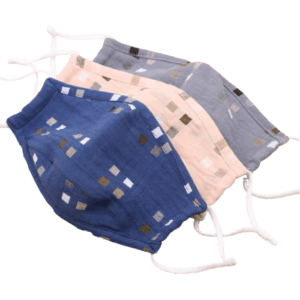

The quest for self-powered wearable electronics has led to a breakthrough in energy harvesting textiles that generate electricity from the subtle mechanical motions of the human body. Unlike traditional piezoelectric materials that rely on crystalline deformation, piezoionic textiles utilize the asymmetric flow of ions within porous, flexible structures, offering higher flexibility, better moisture compatibility, and the ability to generate usable power from low-frequency movements like breathing or speaking. For smart mask manufacturers, this technology promises to eliminate batteries for low-power sensors, creating truly autonomous and maintenance-free wearable systems.
The best piezoionic energy harvesting textiles are flexible, moisture-resilient fabrics composed of asymmetric porous structures—often based on layered nanocomposites of conductive polymers and ionic gels—that convert the mechanical stress from body movement into electrical current through the displacement and redistribution of ions, achieving power densities sufficient to continuously run micro-sensors and low-power microcontrollers integrated directly into the mask fabric. This technology harvests energy from the very act of wearing and breathing, turning the mask itself into a sustainable power source.
The global energy harvesting textiles market is projected to reach $1.2 billion by 2028, with piezoionic mechanisms gaining prominence for their softness and efficiency in humid environments. While piezoelectric ceramics generate high voltage but low current and are brittle, piezoionic materials excel at producing continuous, usable current from the gentle, repetitive strain of a mask flexing during speech or breathing. The key to sourcing lies in understanding material composition, power output under realistic conditions, and integration durability. Let's examine the leading contenders.
What Material Architectures Deliver the Highest Power Density?
The core efficiency of a piezoionic textile depends on its ability to create and maintain a stable ionic concentration gradient within a mechanically responsive matrix. Recent advancements focus on nanostructured composites and asymmetric pore designs.

Why Are Graphene Oxide (GO) Hydrogel Composites Leading?
Graphene oxide hydrogel textiles represent a state-of-the-art architecture. The GO sheets provide a highly porous, mechanically strong scaffold with abundant oxygen-containing functional groups that can bind ions. When infused with an ionic solution (e.g., NaCl or ionic liquids) and laminated with a layer of reduced GO (rGO) or a conductive fabric as an electrode, the system creates a stable ionic gradient. Upon deformation—like the cheek movement behind a mask—ions are selectively transported through the nano-capillaries between GO sheets, generating a continuous current. Research in Nature Communications reports GO-based piezoionic textiles achieving power densities of ~80-120 µW/cm² under biomechanical stress, enough to power a continuous pulse oximeter sensor. The best suppliers offer these as coated fabrics or printable inks with characterized ion exchange capacity.
How Do Conductive Polymer Sponges Compare?
Poly(3,4-ethylenedioxythiophene):poly(styrene sulfonate) (PEDOT:PSS) sponges or foams, infused with mobile ions, offer excellent flexibility and a high inherent conductivity. The PSS component provides fixed sulfonate anions, while mobile cations (like H+ or Na+) move through the porous sponge under stress. These materials can be directly dip-coated or printed onto standard mask fabrics like polyester or nylon. While their peak power density (~50-70 µW/cm²) is slightly lower than GO hydrogels, they excel in durability under repeated washing and mechanical cycling. Sourcing involves finding suppliers who can provide consistent foam porosity and ionic doping levels, which directly impact output.
How Does Humidity and the Breathing Environment Affect Performance?
A mask's microclimate is a challenging environment of high and fluctuating humidity. Unlike piezoelectrics that can degrade with moisture, piezoionic systems often rely on it, but performance must be stable and predictable.

Is High Humidity a Benefit or a Hindrance?
For most piezoionic systems, moderate to high humidity is beneficial but not strictly required. The ionic mobility that drives power generation is enhanced by the presence of water molecules. However, the best materials are engineered to function reliably across a wide range. Systems using ionic liquids (ILs) as the charge carrier are particularly advantageous. ILs are salts that are liquid at room temperature, non-volatile, and hydrophobic. When infused into a textile, they maintain stable ionic conductivity independent of ambient humidity, ensuring the mask generates power consistently whether in dry, air-conditioned air or during strenuous, sweaty activity. Suppliers using IL-based formulations should provide performance data across 20-95% relative humidity.
How is Power Output Optimized for Breathing Frequency?
The human breathing cycle is low frequency (0.1-0.3 Hz during rest). Piezoionic materials generate higher average power from sustained, low-frequency strain rather than sharp impacts. The key is textile design for strain amplitude. Integrating the harvesting fabric in a location that experiences maximum stretch—such as the side panels or chin area of a mask that expands and contracts with jaw movement during speech and breathing—is critical. The mechanical coupling should be designed to translate facial movement into at least 3-5% strain on the active material. Power management circuits must then efficiently rectify and store the harvested AC-like output into a small capacitor or solid-state battery to power electronic loads.
What Are the Integration and Power Management Challenges?
Harvesting nanoscale energy is only half the battle; managing and utilizing it efficiently requires specialized electronics and robust physical integration.

What Power Management ICs (PMICs) are Essential?
The raw output from a piezoionic textile is alternating, low-voltage, and irregular. A specialized energy harvesting PMIC is required to rectify, boost, and regulate this energy to charge a storage element and power a load. Chips like the Texas Instruments BQ25570 or Analog Devices LTC3588 are industry standards. They can start operating with input voltages as low as 20 mV, include maximum power point tracking (MPPT) to optimize harvest from the variable source, and manage power flow between the harvester, storage capacitor, and the load. For mask integration, the PMIC must be available in a wafer-level chip-scale package (WLCSP) to minimize size. Sourcing involves creating a complete reference design with the textile supplier and PMIC manufacturer to ensure compatibility.
How is the Fabric Integrated Without Compromising Comfort or Harvesting?
Integration cannot stiffen the mask or create pressure points. The best method is to use the piezoionic material as a functional coating on an existing, comfortable stretch fabric (e.g., a nylon-spandex blend). The coating is applied in a segmented or grid pattern to maintain the base fabric's breathability and stretch. Electrical connections are made using conductive thread (e.g., silver-plated nylon) embroidered or sewn into the seams, connecting the active zones to the PMIC. The entire assembly must be tested for durability through simulated weeks of use, including the effects of repeated folding and the pressure of the mask against the face. Suppliers should offer pre-characterized, connectorized textile patches for easier integration.
How Do Performance Metrics Compare to Alternative Harvesters?
To justify the integration complexity, piezoionic textiles must offer clear advantages over other small-scale energy harvesters like triboelectric nanogenerators (TENGs) or traditional piezoelectrics in the context of mask wear.

What is the Realistic Usable Power Output?
Under realistic, low-frequency facial movement, the best current piezoionic textiles can generate a continuous average power of 10-30 µW per square centimeter of active fabric. A 10 cm² panel integrated into a mask could therefore yield 100-300 µW. This is sufficient to perpetually power an ultra-low-power microcontroller (like an Arm Cortex-M0+ consuming 30 µA/MHz) and a suite of intermittent sensors (temperature, humidity, basic particulate count) with duty cycling, eliminating the need for a battery. In contrast, a TENG might produce higher peak power but only in pulses, requiring more complex power management, and often suffers from performance degradation in humid conditions.
How Does Long-Term Stability and Washability Compare?
This is a critical differentiator. High-quality piezoionic textiles using ionic liquid electrolytes and robust polymer binders have demonstrated stable output with less than 10% degradation after 100,000 bending cycles and 20+ gentle wash cycles (when properly encapsulated). Traditional piezoelectric ceramic fibers would fracture under such conditions. Triboelectric coatings can wear down or delaminate. For a reusable mask product expected to withstand weekly washing, this long-term stability is paramount. Sourcing requires reviewing accelerated lifecycle test data from the material supplier, specifically for wearable wash-and-bend scenarios.
Conclusion
The best piezoionic energy harvesting textiles for masks are those that combine high ionic conductivity (often via graphene oxide hydrogels or ionic liquid-infused polymers) with robust, flexible textile substrates, delivering stable micro-power generation from breathing and facial movements across varying humidity levels. Their true value is realized when paired with ultra-low-power electronics and sophisticated power management, enabling the dream of perpetually self-powered smart masks that monitor, analyze, and protect without ever needing a charge. While integration challenges remain, the technology has moved from the lab to the pilot production line, ready for forward-thinking manufacturers.
Ready to explore self-powered smart masks with piezoionic energy harvesting? Contact our Business Director, Elaine, at elaine@fumaoclothing.com. Our materials and electronics integration team can help you select, test, and implement the most advanced harvesting textiles to create a truly autonomous and innovative product.