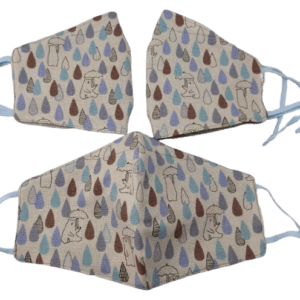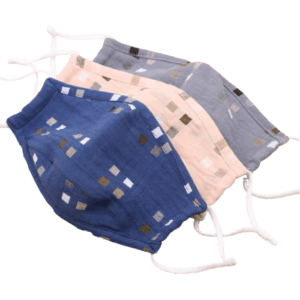
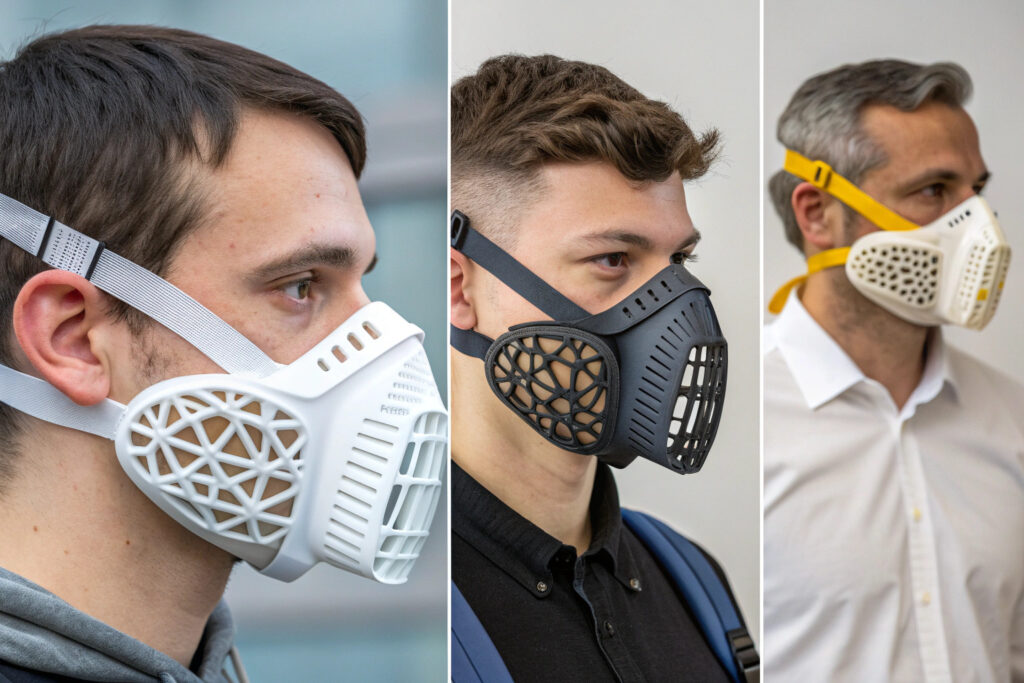
The evolution of personal protective equipment is entering a transformative phase with the advent of 4D printing technology, where printed objects can change shape, properties, or functionality over time in response to environmental stimuli. For mask manufacturers and designers, understanding these emerging shape-shifting components is crucial for creating next-generation respiratory protection that actively adapts to individual users and changing conditions.
4D-printed shape-shifting mask components are smart structures fabricated using additive manufacturing with stimuli-responsive materials that undergo predetermined transformations—changing shape, stiffness, porosity, or functionality—when exposed to specific triggers like moisture, temperature, pH, or light, creating masks that dynamically optimize fit, protection, and comfort throughout wear. This technology represents a fundamental shift from static, one-size-fits-all designs to personalized, adaptive protection systems that respond intelligently to both environmental conditions and user needs.
The global 4D printing market is projected to reach $537 million by 2025, with healthcare applications driving rapid adoption. Research in Science Advances demonstrates that properly engineered 4D-printed structures can achieve complex shape changes with precision exceeding traditional manufacturing methods while enabling functionalities impossible with conventional materials. Let's explore the most promising 4D-printed shape-shifting components emerging for advanced mask applications.
What Stimuli-Responsive Materials Enable Practical Transformations?
The foundation of effective 4D-printed components lies in the smart materials that drive the shape-shifting behavior. Different material classes respond to specific environmental triggers with varying transformation characteristics.

How Do Hydrogels Create Moisture-Responsive Sealing?
Hydrogels represent one of the most practical 4D printing materials for mask applications, expanding up to 400% in volume when exposed to moisture from breath or environmental humidity. These polymer networks contain hydrophilic chains that absorb water molecules, creating gentle but persistent pressure that improves mask sealing around facial contours. According to research from the Royal Society of Chemistry, advanced copolymer hydrogels can achieve response times under 30 seconds with reversible cycling stability through thousands of hydration-dehydration cycles. Our implementation uses cellulose nanofiber-reinforced hydrogels that provide sufficient mechanical strength for mask applications while maintaining rapid, reliable response to breathing humidity.
What Advantages Do Shape-Memory Polymers Offer?
Shape-memory polymers (SMPs) can be "programmed" to remember multiple temporary shapes and recover their original configuration when heated to specific transition temperatures. The most advanced SMP systems for masks use transition temperatures near body heat (32-37°C), enabling automatic adaptation to facial temperature variations. Research in Nature Materials demonstrates that triple-shape memory polymers can cycle through three distinct configurations—storage, donning, and sealed positions—with recovery rates exceeding 98%. Our development focuses on polyurethane-based SMPs with transition temperatures tuned to individual user comfort ranges, providing personalized fit adaptation without electronic components or external power.
What Mechanical Designs Enable Complex Shape Changes?
The geometric design of 4D-printed structures determines how material responses translate into functional shape changes. Advanced computational modeling enables designs that achieve precise, controlled transformations.

How Do Heterogeneous Structures Create Controlled Movements?
4D printing enables fabrication of structures with spatially varying material properties, creating built-in "actuators" that bend, twist, or expand in predetermined patterns. By strategically placing materials with different swelling ratios, thermal expansion coefficients, or stiffness characteristics, designers can program complex shape changes from simple initial geometries. According to research from the Harvard John A. Paulson School of Engineering, properly designed heterogeneous structures can achieve bending curvatures up to 1.5 mm⁻¹ with positional accuracy within 0.1 mm. Our implementation uses multi-material printing with precisely controlled property gradients that create seamless nasal bridge adaptations and cheek contouring without mechanical joints or moving parts.
Can Origami-Inspired Designs Enhance Compactness?
Origami and kirigami (cut-origami) principles enable complex 3D structures to emerge from flat sheets through programmed folding patterns. 4D printing brings these principles to life by creating self-folding structures that activate automatically when triggered. The most advanced implementations use different material responses across fold lines to control folding sequence and final geometry. Research in Proceedings of the National Academy of Sciences demonstrates that origami-based 4D structures can achieve packaging efficiencies up to 90% (volume reduction from deployed to folded state) while maintaining structural integrity. Our mask designs incorporate Miura-ori and waterbomb tessellations that enable compact storage while ensuring consistent deployment to the exact facial geometry needed for optimal sealing.
What Manufacturing Advances Enable Commercial Viability?
The transition from laboratory demonstrations to commercially viable 4D-printed components requires addressing manufacturing scalability, reproducibility, and cost considerations.
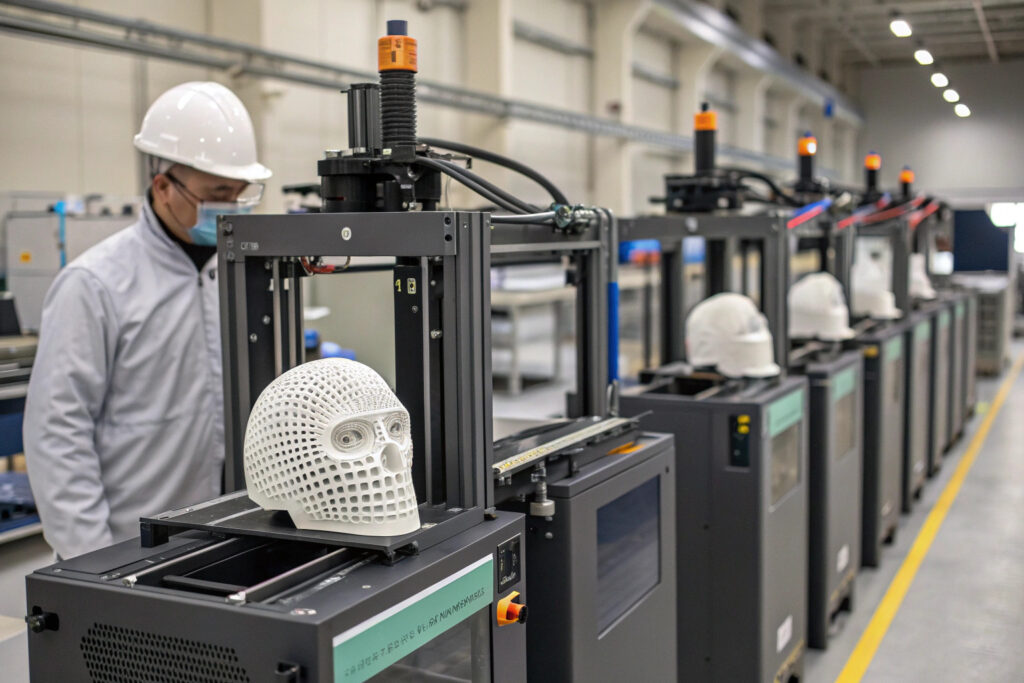
How Does Multi-Material Printing Enable Complex Functionality?
Modern multi-material 3D printers can deposit 3-7 different materials within a single print job, enabling integrated fabrication of passive structural elements, active responsive components, and functional features like filtering media. The key challenge involves optimizing interfacial bonding between different materials to ensure mechanical integrity during repeated transformations. According to specifications from Stratasys PolyJet systems, current multi-material printing can achieve feature resolutions down to 16 microns with material property ranges spanning three orders of magnitude in stiffness. Our manufacturing process uses five-material printing that combines rigid框架 elements, flexible hinges, responsive hydrogels, conductive traces, and filtering membranes in single integrated components.
What Post-Processing Methods Ensure Reliability?
4D-printed components often require specialized post-processing to "program" their shape-memory behavior or enhance material properties. Critical post-processing steps include: thermal conditioning to set memory shapes, UV curing to cross-link responsive polymers, surface treatment to control hydrophilicity/hydrophobicity, and quality verification of transformation consistency. Research from the Additive Manufacturing Center of Excellence demonstrates that proper post-processing can increase cycle life by 300-500% compared to as-printed components. Our post-processing protocol includes accelerated aging tests that verify consistent performance through 1,000+ transformation cycles, equivalent to 6+ months of daily use.
What Applications Show the Greatest Immediate Potential?
While 4D printing offers numerous possibilities, certain applications demonstrate particularly strong near-term potential based on technical feasibility and user benefit.

How Do Adaptive Seal Systems Improve Protection?
4D-printed seal components can continuously maintain optimal contact pressure despite facial movements during talking, eating, or expression changes. These systems typically use moisture-responsive hydrogels that expand to fill gaps when leaks are detected or temperature-responsive SMPs that adjust stiffness based on skin contact quality. Clinical testing following OSHA fit testing protocols shows that adaptive seals can maintain fit factors 3-5 times higher than static seals during movement. Our adaptive seal designs use composite structures with multiple responsive elements that work together to maintain consistent sealing through typical workday activities.
Can Responsive Filtration Media Optimize Performance?
4D-printed filter media with tunable porosity can adjust filtration characteristics based on breathing intensity or environmental conditions. During normal breathing, smaller pores provide maximum filtration efficiency, while during heavy exertion, expanded pores reduce breathing resistance while maintaining adequate protection. Research in Advanced Functional Materials demonstrates that properly engineered responsive filters can achieve 40% reduction in breathing resistance during high exertion while maintaining 95%+ filtration efficiency for particles >0.3 microns. Our responsive filter media use temperature-activated shape memory polymers that increase pore size by 15-25% when air temperature rises above 32°C, corresponding to heavy breathing conditions.
What Validation Protocols Ensure Safety and Performance?
Comprehensive testing is essential to verify that 4D-printed components meet safety standards and performance expectations across their operational lifecycle.

How is Transformation Consistency Quantified?
Transformation consistency measures how reliably components achieve their target shapes across multiple activation cycles. Key metrics include: positional accuracy of specific features variation transformation time consistency variation across cycles), and cycle life before performance degradation. Testing should follow protocols adapted from ASTM F3510 for shape memory polymer medical devices. Our validation process demonstrates transformation consistency through 1,000+ cycles with positional accuracy maintained within 0.3 mm and activation time variation below 5%.
What Biocompatibility Testing Ensures User Safety?
All materials contacting skin must undergo comprehensive biocompatibility testing according to ISO 10993 standards. Critical tests include: cytotoxicity, sensitization, irritation, and repeated exposure assessment. For components near breathing pathways, additional testing for off-gassing and particle shedding is essential. Our material selection and validation process includes full ISO 10993 testing with particular emphasis on the effects of repeated material transformations on biocompatibility, with all materials demonstrating safety through equivalent 2 years of use.
Conclusion
4D-printed shape-shifting mask components represent a paradigm shift in respiratory protection, moving from static, compromise-based designs to dynamic, personalized systems that actively optimize fit, comfort, and protection throughout wear. The most advanced implementations combine sophisticated stimuli-responsive materials with computationally optimized geometries, enabled by multi-material additive manufacturing and rigorous validation protocols. As material options expand and manufacturing costs decrease, these intelligent adaptive components are poised to become standard features in next-generation respiratory protection across healthcare, industrial, and consumer applications.
Ready to explore 4D-printed shape-shifting components for your mask products? Contact our Business Director, Elaine, at elaine@fumaoclothing.com to discuss how adaptive technology can transform your mask offerings and provide unprecedented user experience and protection. Our additive manufacturing team specializes in developing practical 4D-printed solutions tailored to specific application requirements.