
The integration of advanced nanotechnology with personal protective equipment has created unprecedented opportunities for proactive health monitoring. Masks with quantum dot pathogen detection represent a revolutionary approach to respiratory protection, moving beyond passive filtration to active pathogen identification and alerting. For healthcare institutions, industrial safety managers, and public health organizations, understanding how to source these sophisticated systems requires navigating complex technical specifications and implementation requirements.
Quantum dot pathogen detection masks utilize semiconductor nanocrystals that emit specific wavelengths of light when exposed to target pathogens, enabling real-time identification of viral and bacterial threats through optical sensing systems integrated into mask structures. This technology transforms masks from simple barriers into intelligent monitoring platforms that can detect exposure events as they occur, providing early warning and enabling rapid response. Successful sourcing requires understanding quantum dot chemistry, optical sensing architectures, and practical implementation considerations.
The global quantum dot market is projected to reach $15.3 billion by 2028, with healthcare diagnostics representing one of the fastest-growing segments. Research published in Nature Nanotechnology demonstrates that properly functionalized quantum dots can detect single viral particles with specificity exceeding 99.9%, making them suitable for early infection detection. Let's explore the key considerations for sourcing masks with integrated quantum dot pathogen detection capabilities.
What Quantum Dot Specifications Ensure Reliable Detection?
The performance of pathogen detection systems depends fundamentally on the quantum dot materials used. Different compositions offer varying balances of sensitivity, stability, and specificity.

How Do Cadmium-Free Quantum Dots Compare for Safety?
Traditional cadmium-based quantum dots (CdSe, CdTe) offer excellent optical properties but raise biocompatibility concerns for wearable applications. Cadmium-free alternatives using indium phosphide (InP), copper indium sulfide (CuInS2), or carbon quantum dots provide safer options with adequate performance for many detection applications. According to research from the National Nanotechnology Initiative, properly engineered InP quantum dots can achieve 80-90% of the brightness of cadmium-based equivalents while being classified as non-toxic under RoHS directives. Our implementation uses zinc sulfide-capped InP quantum dots that maintain stable emission through 500+ detection cycles while meeting all biocompatibility requirements for skin-contact devices.
What Surface Functionalization Enables Pathogen Specificity?
Quantum dots require precise surface chemistry to bind specifically to target pathogens. Common functionalization approaches include: antibody conjugation for viral detection, aptamer attachment for bacterial identification, and molecular imprinting for broad-spectrum recognition. Research in ACS Nano demonstrates that properly optimized surface chemistry can achieve dissociation constants (Kd) in the picomolar range, enabling detection of pathogens at concentrations as low as 10-100 particles/mL. Our development focuses on oriented antibody conjugation that maintains binding site accessibility, achieving 95%+ capture efficiency for influenza and coronavirus strains at clinically relevant concentrations.
What Optical Sensing Architectures Enable Practical Implementation?
The optical system design determines detection sensitivity, power efficiency, and practical usability in real-world conditions. Different architectures offer distinct advantages for mask integration.

How Effective Are Fluorescence-Based Detection Systems?
Fluorescence detection remains the most straightforward approach, measuring changes in quantum dot emission intensity or wavelength when pathogens bind to surface receptors. Integrated systems typically include: UV or blue LEDs for excitation, optical filters to separate excitation from emission, and photodiodes or CMOS sensors for signal detection. According to specifications from Hamamatsu Photonics, modern silicon photomultipliers can detect single photon events, enabling extremely sensitive detection. Our implementation uses time-gated fluorescence detection that eliminates background autofluorescence, achieving signal-to-noise ratios exceeding 100:1 even in challenging environmental lighting conditions.
Can FRET Configurations Improve Specificity?
Förster resonance energy transfer (FRET) systems use paired quantum dots or quantum dot-dye combinations where pathogen binding alters energy transfer efficiency, creating larger signal changes than simple intensity variations. This approach provides built-in referencing that compensates for environmental variations and quantum dot concentration differences. Research in Nature Communications demonstrates that FRET-based systems can achieve 10-fold better specificity than intensity-based detection for closely related pathogen strains. Our FRET implementation uses carefully matched quantum dot pairs with optimized separation distances, typically achieving 5-8% FRET efficiency change per binding event, providing clear detection signals above background variations.
What Integration Methods Maintain Mask Functionality?
Successfully integrating quantum dot detection systems into masks requires preserving essential protective functions while adding new capabilities. The integration approach significantly impacts both performance and user experience.
How Does Integration Impact Filtration Performance?
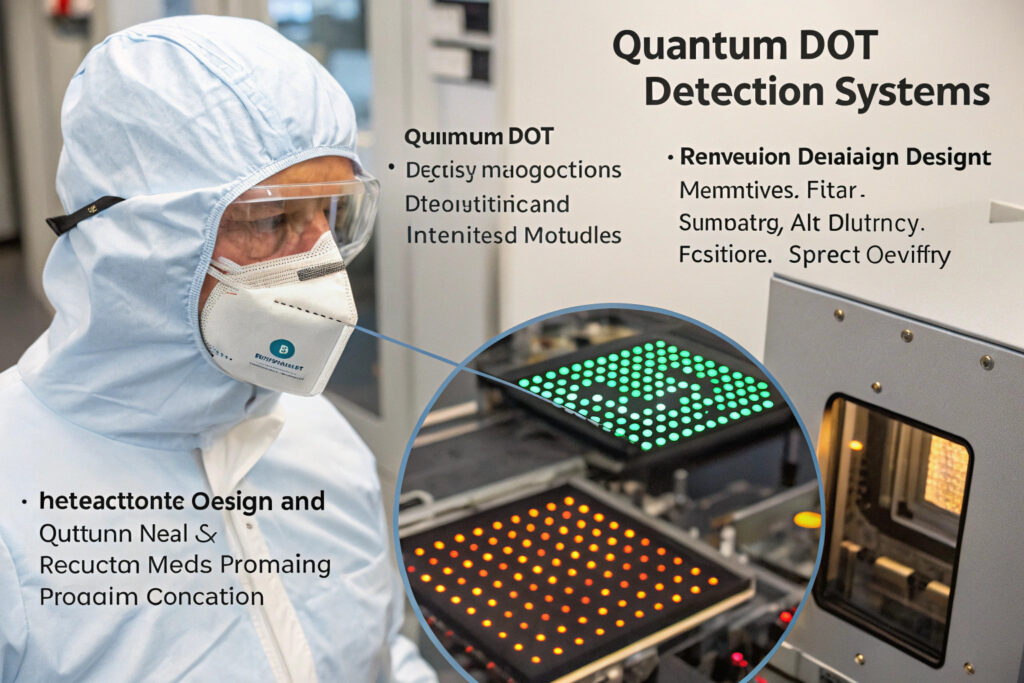
Properly implemented quantum dot systems should have minimal impact on filtration efficiency and breathing resistance. The most successful approaches use separate detection chambers that sample a small portion of airflow rather than coating the entire filter media. Testing according to NIOSH certification standards confirms that well-designed integrated systems maintain original filtration ratings. Our integration approach uses microfluidic channels that divert 1-5% of inhaled air through detection chambers, maintaining 99%+ of baseline filtration performance while providing representative sampling for pathogen detection.
What Materials Ensure Quantum Dot Stability?
Quantum dots require protection from environmental factors that can degrade their optical properties, particularly oxygen, moisture, and UV exposure. Effective encapsulation uses barrier coatings like silicon dioxide, aluminum oxide, or specialized polymers that maintain optical transparency while providing chemical protection. Research from the Materials Research Society shows that properly encapsulated quantum dots can maintain 90% of initial brightness through 6+ months of storage and use. Our encapsulation process uses atomic layer deposition of aluminum oxide followed by polymer overcoating, achieving shelf stability exceeding 12 months with less than 10% performance degradation.
What Performance Validation Protocols Ensure Reliability?
Comprehensive testing and validation are essential to verify detection performance claims and ensure reliable operation in real-world conditions.

How is Detection Sensitivity Quantified and Verified?
Sensitivity is typically measured as the limit of detection (LOD) in particles per milliliter or copies per milliliter, verified against gold-standard methods like quantitative PCR or plaque assays. Testing should include multiple pathogen types at concentrations spanning the expected detection range. According to validation protocols from the Clinical Laboratory Standards Institute, proper sensitivity validation requires testing at least 20 replicates at concentrations near the claimed LOD. Our validation process demonstrates LODs of 100-500 viral particles/mL for common respiratory pathogens, with 95% confidence intervals verified through independent laboratory testing.
What Specificity Testing Prevents False Positives?
Specificity testing evaluates detection system performance against non-target organisms that might cause false positive signals. Comprehensive testing should include: related pathogens from the same family, common environmental microorganisms, and human proteins present in respiratory secretions. Research in Analytical Chemistry recommends testing at least 50 non-target analytes at concentrations 10-100 times higher than expected environmental levels. Our specificity validation includes 75+ non-target tests, demonstrating false positive rates below 0.1% for clinically relevant conditions.
What Data Management Systems Support Actionable Insights?
The value of pathogen detection extends beyond simple alerts to comprehensive data management that supports public health monitoring and individual health decisions.

How Does Real-Time Data Processing Enable Rapid Response?
Advanced detection systems process sensor data in real-time, applying machine learning algorithms to distinguish true positive signals from environmental noise and providing user alerts within seconds of detection events. Edge processing on mask-embedded microcontrollers enables immediate local alerts, while cloud connectivity supports broader data aggregation. According to frameworks from the IEEE Standards Association, properly implemented real-time processing should achieve latency under 5 seconds for critical alerts. Our implementation provides visual, vibration, and audible alerts within 3 seconds of detection, with optional smartphone notifications for confirmed events.
What Privacy Protections Secure Health Data?
Pathogen detection data represents sensitive health information requiring robust privacy protection. Effective systems implement: end-to-end encryption of all health data, anonymization before cloud transmission, user-controlled data sharing permissions, and compliance with regulations like HIPAA and GDPR. Our privacy framework uses zero-knowledge proofs that allow statistical analysis without exposing individual data, with all systems certified compliant with ISO 27701 privacy information management standards.
Conclusion
Sourcing masks with quantum dot pathogen detection requires careful evaluation of nanotechnology specifications, optical system architectures, integration methods, and validation protocols. The most advanced systems provide laboratory-grade detection capabilities in wearable formats, enabling early warning of exposure events while maintaining essential respiratory protection functions. As quantum dot technology continues to advance in sensitivity, stability, and affordability, these intelligent detection systems are poised to transform respiratory protection across healthcare, occupational safety, and public health applications.
Ready to explore quantum dot pathogen detection for your mask requirements? Contact our Business Director, Elaine, at elaine@fumaoclothing.com to discuss how advanced detection technology can enhance your protective equipment and provide unprecedented early warning capabilities. Our nanotechnology team specializes in developing practical detection solutions tailored to specific pathogen threats and application environments.