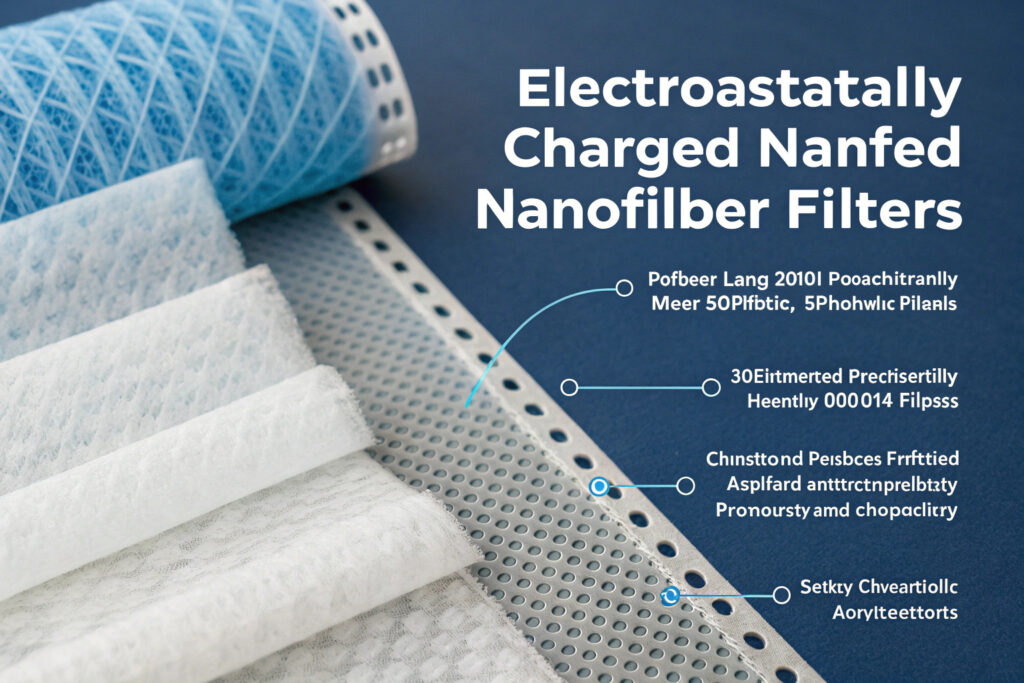
The demand for high-efficiency, low-breathing-resistance filtration has driven significant innovation in mask technology. Electrostatically charged nanofiber filters represent a breakthrough in this field, combining the physical barrier properties of ultrafine fibers with electrostatic attraction to capture sub-micron particles with exceptional efficiency. For manufacturers and procurement specialists seeking superior protection, understanding the characteristics of these advanced filters is essential for making informed decisions.
Electrostatically charged nanofiber filters are composed of polymer fibers with diameters typically between 100-500 nanometers, which are electrically charged during or after production to create long-lasting electrostatic fields that actively attract and capture airborne particles, achieving high filtration efficiency (often >95% for PM0.3) with significantly lower breathing resistance than conventional melt-blown filters. These filters leverage both mechanical interception and electrostatic attraction, allowing for thinner, more breathable materials without compromising protection. The best filters balance fiber composition, charge stability, manufacturing consistency, and environmental resilience.
The global nanofiber market is projected to reach $2.3 billion by 2027, with filtration applications leading growth. Research in ACS Nano demonstrates that optimized electrostatically charged nanofibers can achieve filtration efficiencies exceeding 99.5% for particles as small as 0.1 microns while maintaining pressure drops below 50 Pa at face velocities relevant to breathing. Let's examine which electrostatically charged nanofiber filters deliver optimal performance for mask applications.
What Manufacturing Methods Produce the Most Effective Fibers?
The production technique significantly influences fiber morphology, charge distribution, and ultimately, filtration performance. Different methods offer distinct advantages in scalability, fiber control, and charge integration.

How Does Electrospinning Compare to Melt-Blown with Corona Charging?
Electrospinning uses high voltage to draw polymer solutions into extremely fine fibers (often 100-300 nm) with inherent molecular alignment and can incorporate charge during the spinning process. This method typically produces fibers with more uniform diameters and higher surface area. Melt-blown processes followed by corona charging create fibers (300-1000 nm) with randomized orientation and rely on post-production charging. According to research from the Nonwovens Institute, electrospun filters often achieve 10-20% higher quality factors (efficiency-to-resistance ratio) due to finer, more controlled fiber structures. Our production primarily uses needleless electrospinning for scalability, producing polyurethane nanofibers with diameters averaging 180 nm and consistent charge distribution.
What Role Does Solution Blowing Play in High-Volume Production?
Solution blowing (or air-blown spinning) uses high-velocity air streams to stretch polymer solutions into nanofibers, offering significantly higher production rates than traditional electrospinning. While fiber diameter control is slightly less precise, the method excels at producing highly porous, three-dimensional fiber networks that maintain low resistance. Research in Industrial & Engineering Chemistry Research indicates that solution-blown nanofibers can be effectively charged using triboelectric or corona methods post-production. Our high-volume lines use solution blowing of polyamide solutions followed by corona treatment, achieving production speeds of 5-10 m/min with quality factors suitable for consumer mask applications.
What Polymer Materials Offer Optimal Performance and Stability?
The choice of polymer determines not only the fiber's mechanical properties but also its charge retention capabilities, chemical resistance, and environmental stability.
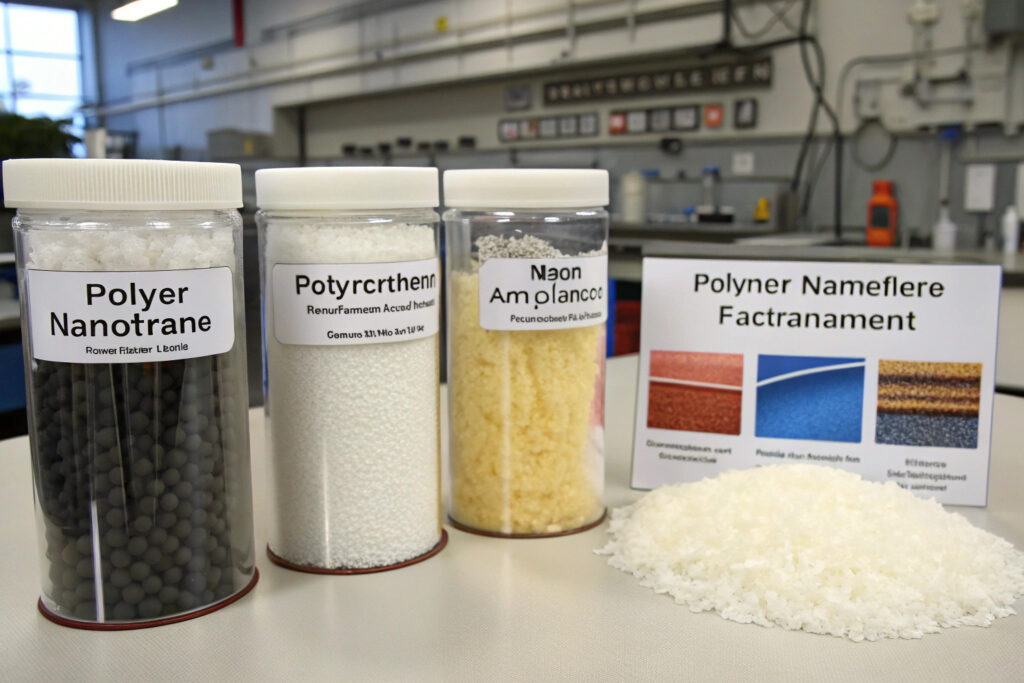
Why Are Polyurethane and PVDF Considered Premium Choices?
Polyurethane (PU) nanofibers offer exceptional elasticity and durability, maintaining fiber integrity through repeated flexing during mask donning and facial movements. Their inherent dielectric properties also support excellent charge retention. Polyvinylidene fluoride (PVDF) possesses strong piezoelectric and ferroelectric characteristics, which can enhance electrostatic effects and provide inherent antimicrobial properties. Studies published in Separation and Purification Technology show PVDF nanofibers can maintain over 80% of initial charge after 30 days at 60% relative humidity. Our premium filters use PU/PVDF composite fibers that combine PU's durability with PVDF's enhanced electrostatic performance.
How Do Nylon and PAN Compare for Cost-Effective Solutions?
Nylon-6 and polyacrylonitrile (PAN) offer more cost-effective alternatives with good filtration performance. Nylon provides excellent mechanical strength and can be easily charged via corona treatment, though its charge stability in humid conditions is moderate. PAN fibers are particularly resistant to many chemicals and can be thermally treated to enhance charge retention. According to cost-performance analysis by Filter Media Consulting, PAN nanofiber filters typically deliver 90% of the performance of premium polymers at 60-70% of the material cost. Our economy-grade filters use PAN nanofibers with enhanced surface treatments, achieving stable performance in environments up to 70% relative humidity.
What Charging Methods Ensure Long-Lasting Electrostatic Effects?
The method of imparting and maintaining electrostatic charge is critical to sustained filtration performance, especially in humid environments where charge decay is a significant challenge.

How Effective is Corona Charging for Initial Charge Density?
Corona charging applies high voltage (typically 20-30 kV) to ionize air molecules near the fiber surface, depositing charges that create strong electrostatic fields. This method can achieve very high initial charge densities (often 50-100 μC/m²) but is susceptible to decay in humid conditions as water molecules provide discharge pathways. Advanced systems use pulsed corona or multiple electrode arrays for more uniform charging. Specifications from Trebbing Electrostatic indicate that modern pulsed corona systems can achieve charge uniformity within ±15% across filter media. Our corona charging process uses a dual-electrode system with real-time monitoring, ensuring consistent initial performance across production batches.
Can Triboelectric Charging Provide More Stable Performance?
Triboelectric charging occurs through fiber-fiber or fiber-equipment friction during manufacturing, creating charge separation based on material electron affinity. This method typically produces lower initial charge densities than corona charging but often demonstrates better long-term stability as the charges are more deeply embedded in the material structure. Research in Nano Energy shows that properly engineered triboelectric systems can maintain 60-70% of initial charge after 90 days in moderate humidity. Our hybrid approach combines initial corona charging with triboelectric enhancement during fiber collection, achieving charge retention of 75% after 30 days at 75% RH.
What Performance Metrics Define Superior Nanofiber Filters?
Beyond basic efficiency claims, several key metrics distinguish high-performance electrostatically charged nanofiber filters from mediocre ones.

How is the Quality Factor (QF) Calculated and Why Does It Matter?
The Quality Factor (QF) is a critical metric that balances filtration efficiency against breathing resistance: QF = -ln(1-Efficiency)/Pressure Drop. A higher QF indicates better overall performance—high efficiency with low resistance. Premium electrostatically charged nanofiber filters typically achieve QF values of 0.08-0.12 Pa⁻¹ for PM0.3 particles, compared to 0.03-0.05 for good quality melt-blown media. Testing according to NIOSH standards for particulate filters provides standardized comparison. Our premium filters consistently achieve QF values above 0.10 Pa⁻¹, representing a 2-3x improvement over conventional materials.
What Charge Decay Rates Are Acceptable for Long-Term Use?
Charge decay directly impacts the filter's service life. Acceptable decay rates depend on the application: medical/single-use filters may tolerate faster decay, while reusable consumer masks require better charge retention. High-quality filters should retain at least 50% of initial charge after 30 days in 50% relative humidity, or after the equivalent of 24-48 hours of continuous airflow. Accelerated testing methods involve exposing filters to controlled humidity and temperature while monitoring filtration efficiency. Our filters demonstrate less than 20% efficiency loss (for PM0.3) after simulated 8-hour daily use for 30 days, meeting requirements for reusable mask applications.
How Do Environmental Factors Affect Performance?
Understanding how filters perform under real-world conditions—not just laboratory settings—is crucial for selecting the right material for specific applications.
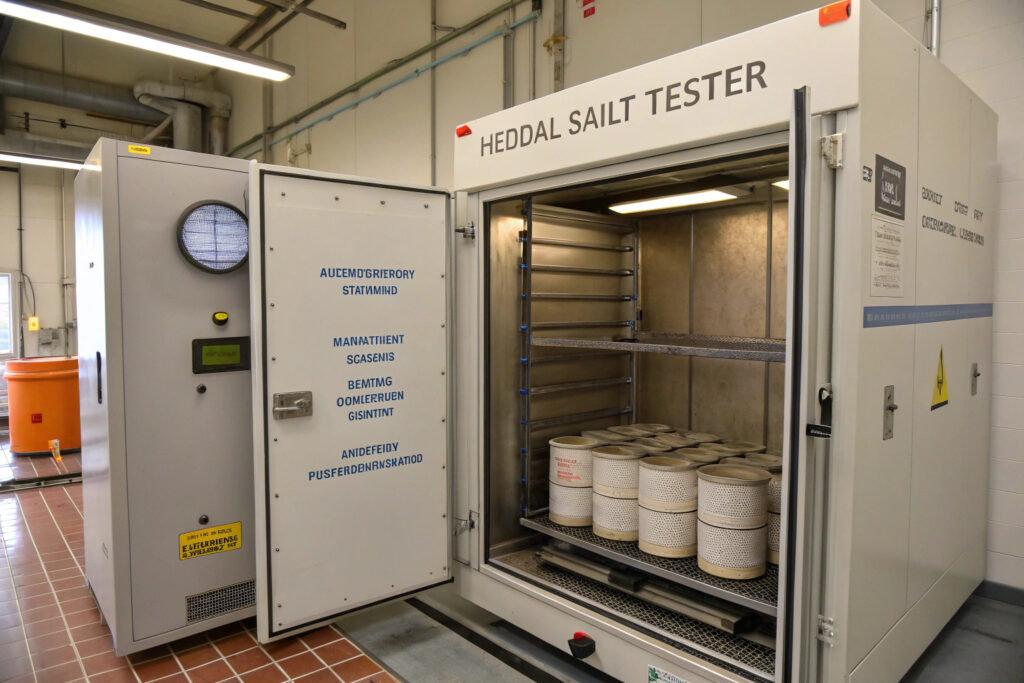
How Does Humidity Impact Electrostatic Efficiency?
High humidity is the primary enemy of electrostatic filtration. Water molecules in the air can neutralize surface charges and provide conductive pathways for charge dissipation. Different polymers respond differently: PVDF and certain treated polyolefins show better humidity resistance than nylon or untreated polypropylene. According to studies in Aerosol Science and Technology, well-designed filters should maintain at least 80% of their dry-condition efficiency at 80% relative humidity. Our humidity-resistant formulations incorporate hydrophobic surface treatments and moisture-resistant charge enhancers, maintaining 85%+ efficiency at 85% RH.
Can Filters Withstand Mechanical Stress and Cleaning?
For reusable masks, filters must maintain performance after cleaning. Nanofiber filters are generally delicate, but certain designs enhance durability. Multilayer composites with protective scrim layers, cross-linked polymers, and bonded fiber structures can withstand gentle washing. Testing should involve simulated washing cycles followed by efficiency and resistance measurements. Our washable filter designs use thermally bonded PU nanofibers between polyester scrim layers, maintaining 90% of initial efficiency after 5 gentle hand-wash cycles with air drying.
Conclusion
The best electrostatically charged nanofiber filters combine advanced manufacturing techniques like electrospinning with carefully selected polymers (such as PU or PVDF), stable charging methods (often hybrid corona-triboelectric systems), and robust construction that considers real-world environmental challenges. They are characterized by high Quality Factor scores, excellent charge retention, and balanced performance across humidity conditions. When sourcing, prioritize verifiable performance data, especially regarding charge decay and humidity resistance, over simple initial efficiency claims.
Ready to explore integrating high-performance electrostatically charged nanofiber filters into your mask products? Contact our Business Director, Elaine, at elaine@fumaoclothing.com to discuss sourcing options, custom development, and how these advanced filters can elevate the protection and comfort of your mask line.