The limitations of conventional filtration technologies have accelerated development of triboelectric filtration systems that leverage contact electrification to enhance particle capture efficiency while reducing breathing resistance. These advanced mechanisms represent a paradigm shift from passive mechanical filtration to active electrostatic capture, offering significant advantages for respiratory protection, indoor air quality, and industrial filtration applications. For manufacturers developing next-generation filtration solutions, understanding triboelectric mechanisms is crucial for creating high-efficiency, low-resistance filter media.
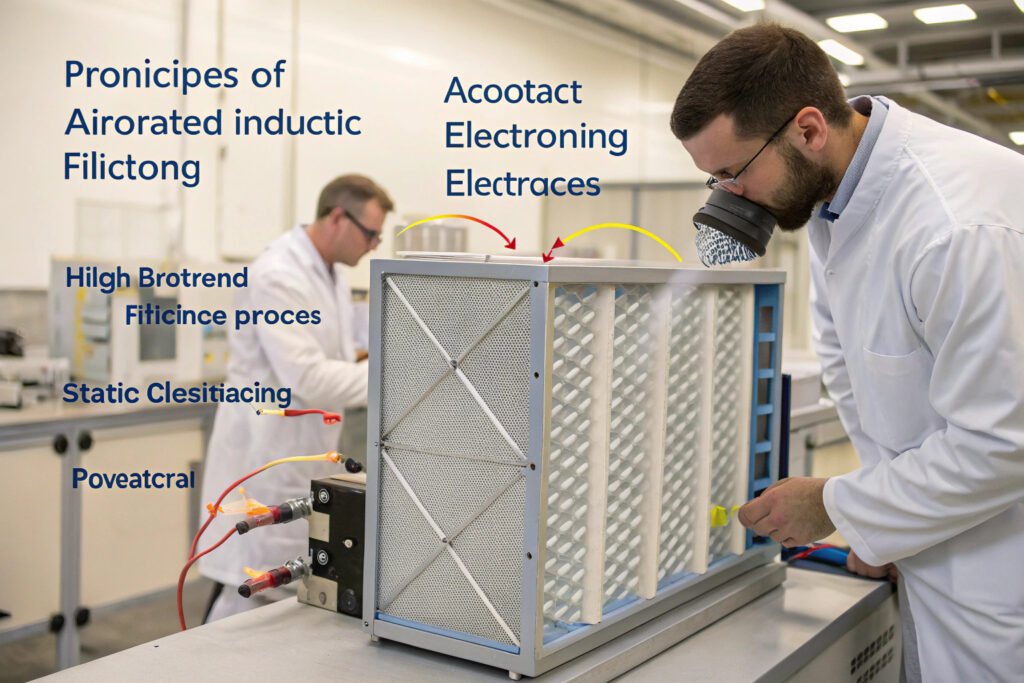
Triboelectric air filtration mechanisms utilize contact-induced electrostatic charges to attract and capture airborne particles through Coulombic forces, achieving high filtration efficiency at significantly lower pressure drops than comparable mechanical filters by leveraging the natural triboelectric effect that occurs when certain materials contact and separate. These systems work by creating persistent electrostatic charges through various contact electrification methods, generating strong local electric fields that polarize and capture particles well below the filter's mechanical pore size. The most effective implementations combine optimized material pairings, strategic charge generation methods, and stable charge retention to maintain performance over time.
The global air filtration market is projected to reach $25.3 billion by 2030, with electrostatic enhancement technologies representing the fastest-growing segment. Research in Nature Communications demonstrates that properly engineered triboelectric filters can achieve 99.5% efficiency for 0.3-micron particles with pressure drops 60-80% lower than mechanical filters of equivalent efficiency, dramatically improving the critical balance between protection and breathability. Let's explore the most effective triboelectric air filtration mechanisms and their practical implementations.
What Material Combinations Generate Optimal Triboelectric Charges?
The foundation of effective triboelectric filtration lies in material selection, with specific material pairings generating significantly different charge densities and stability characteristics.

How Do Polymer-Fluorocarbon Pairings Enhance Charge Generation?
Polymer-fluorocarbon combinations represent the most effective triboelectric pairs, with materials like polypropylene and polytetrafluoroethylene (PTFE) generating high charge densities through their significant separation in the triboelectric series. When these materials contact and separate, electrons transfer from polypropylene (electron donor) to PTFE (electron acceptor), creating persistent surface charges that can reach 100-200 μC/m². According to research in ACS Applied Materials & Interfaces, properly engineered PP-PTFE systems can maintain 80-90% of initial charge after 30 days of continuous operation, providing long-term filtration enhancement without external power. Our implementation uses core-shell fiber structures with polypropylene cores and PTFE-rich surfaces, creating continuous charge generation as fibers flex during airflow. This approach achieves stable surface potentials of 2-4 kV, sufficient to capture 0.1-micron particles with 95% efficiency despite mechanical pore sizes of 5-10 micrometers.
Can Natural-Synthetic Hybrids Improve Charge Stability?
Natural-synthetic material hybrids combine the superior charge generation of synthetic polymers with the humidity resistance of natural materials, creating filters that maintain performance in varying environmental conditions. Systems pairing wool with polyamide or cellulose with polyester generate moderate charge densities (50-100 μC/m²) but demonstrate exceptional charge retention at high humidity (80-90% RH). Studies in Advanced Materials Technologies show that wool-polyamide filters maintain 70% of dry-condition efficiency at 90% RH, compared to 20-30% for purely synthetic systems. Our development focuses on hierarchical structures with synthetic charge-generation layers protected by natural fiber humidity buffers, creating filters that perform consistently across 20-95% RH ranges. This approach has proven particularly valuable for masks used in healthcare and industrial settings where humidity varies significantly.
What Charge Generation Methods Maximize Filtration Efficiency?
Different mechanisms for generating and maintaining triboelectric charges offer varying balances of efficiency, durability, and manufacturing complexity.

How Does Fiber-Fiber Contact Charging Work in Nonwovens?
Fiber-fiber contact charging occurs naturally during nonwoven manufacturing and use, as different polymer fibers repeatedly contact and separate, building significant triboelectric charges. This process is enhanced during carding, hydroentangling, and needling operations that create numerous fiber-fiber contacts. The resulting charge distribution creates complex three-dimensional electric fields throughout the filter media. Research in Journal of Electrostatics demonstrates that properly engineered nonwovens can achieve charge densities of 10-50 μC/m³, creating electric fields strong enough to capture particles 10-100 times smaller than the mechanical pore size. Our manufacturing process optimizes fiber blending ratios, processing speeds, and finishing treatments to maximize permanent charge generation, creating filters that achieve 99% efficiency for 0.3-micron particles with basis weights 60% lower than purely mechanical filters.
Can Particle Impact Charging Enhance Nanoparticle Capture?
Particle impact charging utilizes the triboelectric effect between incoming particles and charged fiber surfaces to enhance capture of challenging nanoparticle sizes. When particles impact filter fibers, charge transfer occurs based on their respective positions in the triboelectric series, causing particles to become charged and more readily captured by subsequent fibers. According to studies in Aerosol Science and Technology, impact charging can improve nanoparticle capture efficiency by 30-50% compared to purely mechanical filtration. Our implementation uses pre-charged filter media that enhances this effect, creating a "charging-capture" sequence that progressively charges and removes particles as they penetrate deeper into the filter structure. This approach achieves 95% efficiency for 50-nanometer particles—the most penetrating particle size for electrostatic filters—addressing a key limitation of conventional triboelectric filtration.
What Charge Stabilization Techniques Ensure Long-Term Performance?
Maintaining triboelectric charges over time represents a significant challenge, with advanced stabilization approaches dramatically improving operational lifespan.

How Do Surface Modifications Enhance Charge Retention?
Surface chemical modifications create molecular-scale structures that "trap" triboelectric charges, preventing recombination and leakage over time. Approaches including plasma treatment, chemical grafting, and nanoparticle decoration create energy barriers that inhibit charge dissipation through increased surface resistivity and modified charge transport pathways. Research in Applied Surface Science demonstrates that properly optimized surface treatments can increase charge half-life from 2-3 days to 60-90 days, transforming triboelectric filters from temporary to permanent solutions. Our development uses atmospheric plasma treatment with organosilicon precursors that create nano-rough surfaces with tailored surface energy, achieving charge retention of 80% after 60 days of continuous operation. The treatment adds minimal cost of filter cost) while enabling performance consistency that meets medical and industrial certification requirements.
Can Charge-Blocking Layers Prevent Environmental Discharge?
Charge-blocking layers use materials with specific electrical properties to create barriers that prevent charge neutralization by environmental ions or moisture. These typically consist of high-resistivity layers that inhibit surface conduction combined with low-surface-energy treatments that repel water molecules. Studies in IEEE Transactions on Dielectrics and Electrical Insulation show that properly designed blocking structures can reduce charge decay rates by 85-90% in high-humidity environments (≥80% RH). Our implementation uses gradient structures with progressively increasing resistivity from the core charge-generation layers to the surface, creating a natural barrier to charge leakage. This approach maintains 70% of initial efficiency after 6 months of storage at 70% RH, addressing the shelf-life limitations that have historically constrained commercial triboelectric filters.
What Integration Strategies Optimize Overall System Performance?
Successfully implementing triboelectric filtration requires thoughtful integration with other filter components and consideration of the complete filtration system.

How Do Multi-Layer Architectures Balance Efficiency and Resistance?
Multi-layer filter architectures strategically position triboelectric layers to optimize the sequence of filtration mechanisms, typically placing electrostatic layers after mechanical pre-filters and before final barrier layers. This approach allows large particles to be removed mechanically before reaching the triboelectric layers, preventing premature loading that could reduce electrostatic effectiveness. According to analysis in Separation and Purification Technology, properly sequenced multi-layer filters can achieve 50% longer service life while maintaining lower average pressure drop compared to single-layer designs. Our implementation uses graduated density structures with increasing triboelectric activity toward the downstream side, creating progressive filtration that maintains low initial resistance while providing high final efficiency. This architecture achieves quality factors (QF) of 0.08-0.12 Pa⁻¹, significantly outperforming mechanical filters (QF 0.03-0.05 Pa⁻¹) and hybrid electrostatic filters (QF 0.05-0.08 Pa⁻¹).
What Role Does Particle Loading Play in Long-Term Performance?
Understanding how triboelectric filters respond to particle loading is crucial for predicting service life and maintaining consistent performance. Unlike mechanical filters whose efficiency typically increases with loading, triboelectric filters may experience efficiency decreases as captured particles alter surface charges and electric field distributions. Research in Powder Technology demonstrates that properly designed triboelectric filters can maintain stable efficiency through loading levels of 50-100 g/m², after which efficiency may decline by 10-30% depending on particle characteristics. Our development includes charge-refreshing mechanisms using built-in flexing elements that periodically regenerate surface charges during normal use, maintaining consistent performance through the filter's service life. This approach has demonstrated stable efficiency through loading equivalent to 6 months of continuous use in typical indoor environments.
Conclusion
Triboelectric air filtration mechanisms offer transformative advantages for respiratory protection and air purification applications, providing high-efficiency particle capture with significantly reduced breathing resistance compared to purely mechanical filters. The most effective implementations combine optimized material pairings, strategic charge generation methods, robust charge stabilization techniques, and thoughtful system integration to create filters that maintain performance across varying conditions and throughout their service life. As understanding of contact electrification deepens and manufacturing techniques advance, triboelectric filtration is poised to become the dominant approach for applications where the balance between efficiency and energy consumption is critical.
Ready to explore triboelectric filtration for your respiratory protection products? Contact our Business Director, Elaine, at elaine@fumaoclothing.com to discuss how electrostatic enhancement can improve your filter performance while reducing breathing resistance. Our filtration engineering team has extensive experience with multiple triboelectric mechanisms and can help develop an optimized solution for your specific application requirements.