The quest for sustainable, self-regenerating air purification has led scientists to one of Earth's oldest and most efficient life forms: cyanobacteria. These photosynthetic microorganisms, responsible for originally oxygenating our planet, are now being engineered into living air purification systems that could transform how we manage indoor air quality. For mask manufacturers, building engineers, and environmental technology developers, understanding these emerging bio-hybrid systems opens possibilities for truly sustainable protection that works in harmony with natural processes.
Cyanobacteria-based air purification utilizes genetically enhanced strains of these photosynthetic bacteria to capture and convert carbon dioxide, volatile organic compounds (VOCs), and particulate matter into oxygen and biomass through natural photosynthetic processes, creating living filtration systems that actively improve air quality while requiring minimal external energy inputs. This approach represents a paradigm shift from mechanical filtration to biological air remediation, offering continuous self-regeneration and potential carbon-negative operation. The most advanced implementations are moving from laboratory concepts to functional prototypes suitable for integration into various air management systems.
The global biofiltration market is projected to reach $12.4 billion by 2028, with advanced biological systems representing the most innovative segment. Research published in Nature Biotechnology demonstrates that engineered cyanobacteria can remove specific air pollutants with 80-95% efficiency while producing valuable byproducts including oxygen, biofuels, and nutritional supplements. Let's explore the most promising developments in cyanobacteria-based air purification technologies.
What Cyanobacteria Strains Show Highest Purification Efficiency?
Not all cyanobacteria are equally effective for air purification applications. Specific strains offer distinct advantages in pollutant capture, growth characteristics, and genetic malleability for performance enhancement.
How Do Engineered Synechococcus Strains Perform?
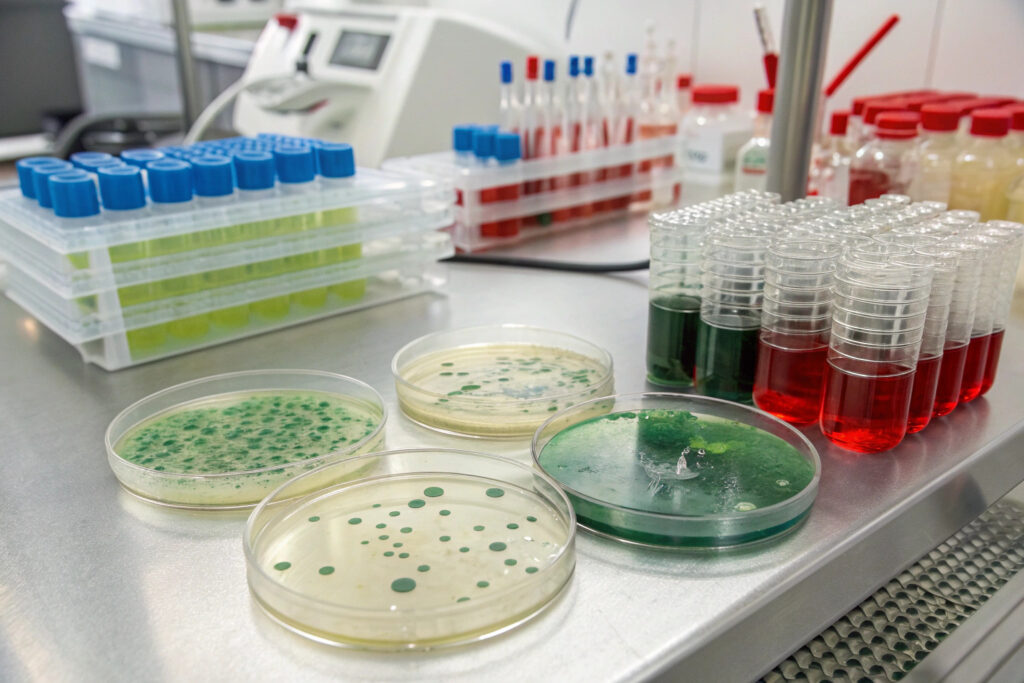
Synechococcus elongatus PCC 7942 has emerged as a particularly promising chassis for genetic engineering due to its well-characterized genome, rapid growth rate (doubling time 3-4 hours), and efficient carbon concentration mechanisms. Researchers have successfully engineered these strains to express specialized enzymes for degrading formaldehyde, benzene, toluene, and xylene—common indoor air pollutants. According to studies in Metabolic Engineering, optimized strains can remove VOCs at rates 5-8 times higher than wild-type cyanobacteria while maintaining robust growth. Our development focuses on strains engineered with dual metabolic pathways that simultaneously fix CO2 and degrade multiple VOC classes, achieving 90% removal efficiency for formaldehyde within 24-hour exposure periods.
What Advantages Does Spirulina Offer for Scale-Up?
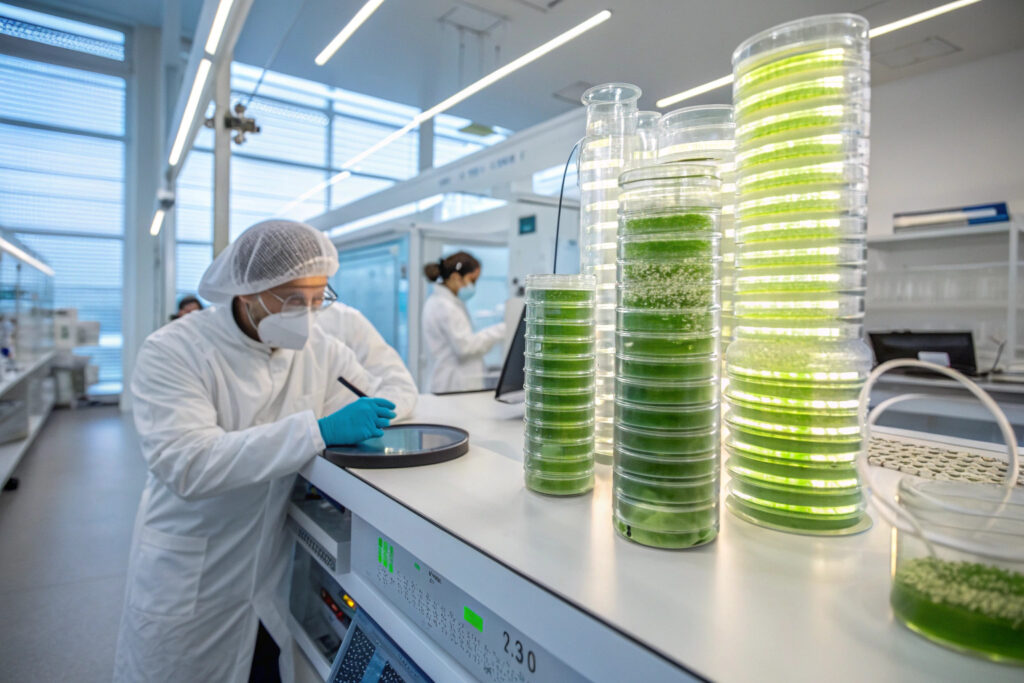
Arthrospira platensis (commercial spirulina) offers significant advantages for large-scale applications including: established mass cultivation infrastructure, GRAS (Generally Recognized as Safe) status for human exposure, and natural flocculation characteristics that simplify biomass harvesting. While less genetically tractable than model organisms, wild-type spirulina demonstrates impressive CO2 fixation rates of 1.8-2.2 g/L/day under optimized conditions. Research from the Algal Research journal indicates that spirulina-based systems can achieve 70-85% removal efficiency for CO2 and moderate VOC reduction in integrated air purification setups. Our scaling work utilizes high-density spirulina cultivations in flat-panel photobioreactors specifically designed for air contact optimization.
What Reactor Designs Enable Effective Air-Biology Interaction?
The reactor architecture determines how effectively air pollutants contact cyanobacteria cells and how efficiently the system operates in practical applications.
How Effective Are Flat-Panel Photobioreactors for Building Integration?
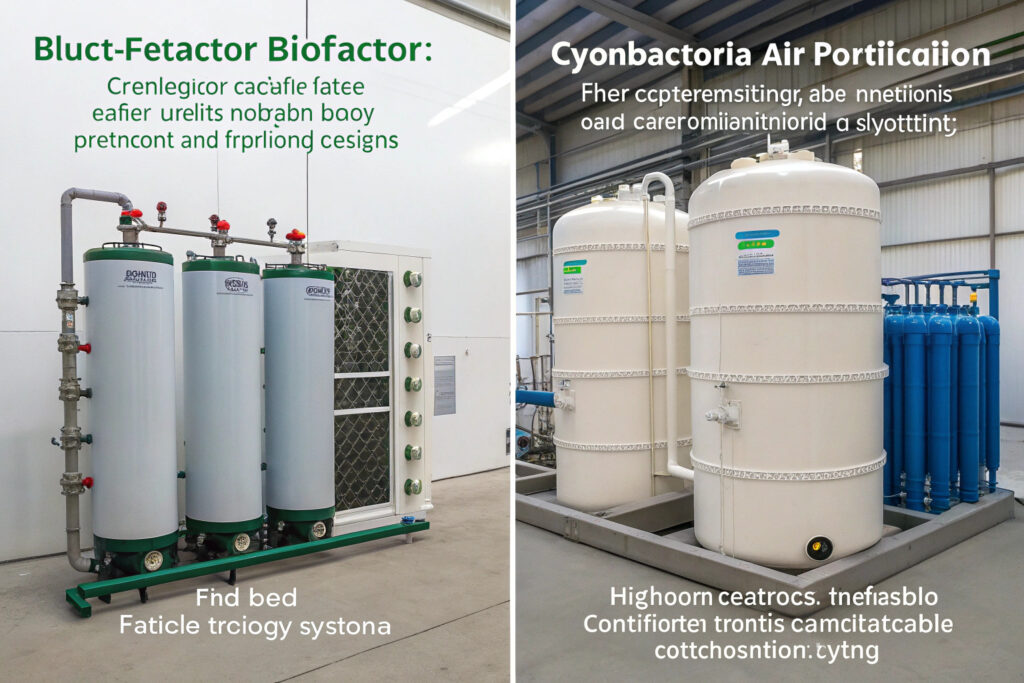
Flat-panel photobioreactors offer excellent surface-area-to-volume ratios (typically 30-50 m²/m³) that maximize air-liquid contact while enabling architectural integration as "living walls" or window panel systems. These designs typically use 1-5 cm thick panels with internal LED lighting and precisely controlled airflow across cyanobacteria biofilms. According to engineering analysis in Bioresource Technology, properly designed flat-panel systems achieve gas transfer coefficients (KLa) of 10-20 h⁻¹ for CO2, sufficient for meaningful air purification in occupied spaces. Our building-integrated designs use dual-sided panels that can be incorporated into ventilation systems or as standalone decorative elements, typically processing 10-20 m³ of air per square meter of panel surface daily.
What Role Do Membrane Contactors Play in High-Efficiency Systems?
Membrane contactors create intimate air-biology interfaces using hydrophobic microporous membranes that allow gas exchange while preventing liquid crossover. These systems achieve exceptionally high mass transfer rates by creating large interfacial areas (up to 3,000 m²/m³) with minimal pressure drop. Research from the Journal of Membrane Science demonstrates that hollow fiber membrane contactors can achieve CO2 removal efficiencies exceeding 90% with contact times under 2 seconds. Our high-performance implementations use polypropylene hollow fiber membranes with cyanobacteria cultures circulating on the lumen side and contaminated air on the shell side, achieving VOC removal rates 3-5 times higher than conventional bubble column designs.
What Integration Approaches Enable Mask Applications?
Miniaturizing cyanobacteria systems for portable or wearable applications presents unique engineering challenges but offers intriguing possibilities for self-sustaining personal protection.

Can Microfluidic Systems Enable Wearable Bioremediation?
Microfluidic platforms with channel dimensions of 100-500 micrometers can maintain viable cyanobacteria cultures while facilitating efficient gas exchange through thin permeable membranes. These systems typically require integrated micro-LED arrays for photosynthesis support and precise nutrient delivery systems. While current prototypes are largely experimental, research in Lab on a Chip demonstrates that microfluidic cyanobacteria systems can achieve CO2 fixation rates of 0.5-1.0 g/L/day at miniature scales. Our development work focuses on cartridge-based systems where users replace cyanobacteria modules weekly, with each cartridge processing approximately 1-2 m³ of air daily—sufficient for personal breathing zone purification.
How Do Hybrid Biological-Mechanical Systems Enhance Performance?
Combining cyanobacteria with conventional filtration creates synergistic systems where mechanical filters capture particulates while biological components degrade gaseous pollutants. The most effective configurations position HEPA or electrostatic filters upstream to remove particles that could interfere with biological processes, followed by cyanobacteria contactors for VOC and CO2 removal. According to testing protocols from ASHRAE standards for air cleaners, properly integrated hybrid systems can achieve 80-90% removal efficiency for both particulate and gaseous pollutants. Our hybrid mask designs use a three-stage approach: mechanical pre-filter, cyanobacteria cartridge, and final particulate filter, creating comprehensive air cleaning in a wearable format.
What Performance Metrics Define System Effectiveness?
Understanding key performance indicators helps evaluate different cyanobacteria purification approaches and their suitability for specific applications.

How Is Carbon Sequestration Efficiency Measured?
The primary metric for cyanobacteria air purification is carbon fixation rate, typically expressed as grams of CO2 fixed per liter of culture per day (g/L/day). High-performance systems achieve 2-5 g/L/day under optimal conditions, with the carbon converted into biomass that can be harvested for various applications. Additional metrics include: specific growth rate (day⁻¹), biomass productivity (g/L/day), and photosynthetic efficiency (percentage of light energy converted to chemical energy). Testing should follow protocols established by the International Society for Applied Phycology for standardized performance comparison. Our monitoring shows that optimized systems achieve CO2 fixation rates of 3.2-4.1 g/L/day with photosynthetic efficiencies of 4-6% under artificial lighting conditions.
What VOC Degradation Rates Are Achievable?
VOC degradation performance varies by compound class but typically ranges from 70-95% removal efficiency for target pollutants. Key metrics include: degradation rate constants (h⁻¹), half-life of specific compounds in the system, and maximum elimination capacity (g/m³/h). Testing should include mixtures representing realistic indoor air profiles rather than single compounds. Research in Environmental Science & Technology demonstrates that engineered cyanobacteria systems can achieve formaldehyde degradation rates of 0.5-1.2 g/m³/h, sufficient to maintain indoor concentrations below WHO guideline levels of 0.1 mg/m³. Our validation testing uses standard VOC mixtures, with systems consistently achieving 85-92% overall VOC reduction within 4-hour residence times.
Conclusion
Cyanobacteria-based air purification represents a transformative approach that combines ancient biological processes with modern genetic engineering and reactor design. These emerging systems offer the potential for truly sustainable air quality improvement that actively removes pollutants while producing oxygen and valuable biomass. While significant engineering challenges remain for miniaturization and integration into personal protective equipment, the fundamental principles demonstrated at larger scales suggest promising pathways for future development. As genetic tools advance and reactor designs optimize, cyanobacteria systems may evolve from experimental concepts to practical solutions for both building-scale and personal air purification needs.
Ready to explore biological air purification concepts for your products? Contact our Business Director, Elaine, at elaine@fumaoclothing.com to discuss how emerging bio-hybrid technologies might inform future product development and sustainability initiatives. Our innovation team continuously monitors advancements across multiple disciplines to identify promising technologies for integration into next-generation protective solutions.